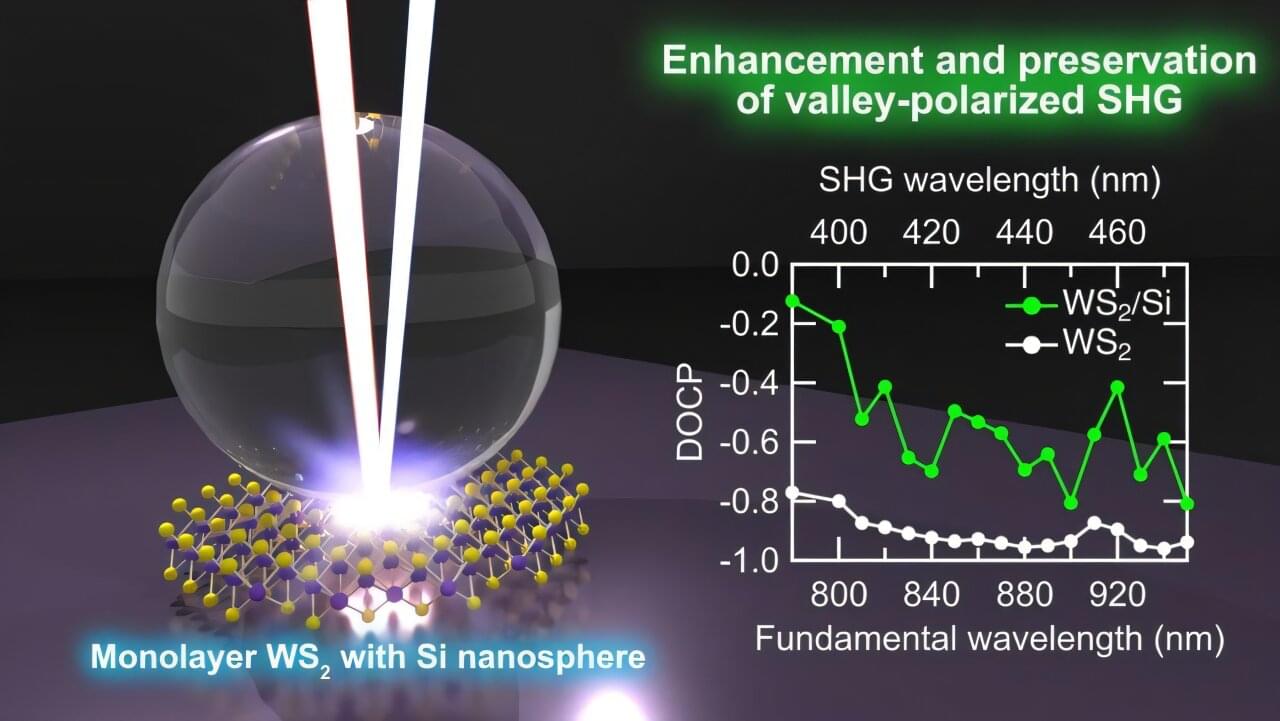
A research team has demonstrated that silicon nanospheres can strongly enhance second-harmonic generation (SHG) from an atomically thin semiconductor while preserving the circular polarization information tied to its valley degree of freedom. The study, published in Nano Letters, provides design guidelines for efficient, polarization-preserving nonlinear light sources at the nanoscale.
SHG is a nonlinear optical process that converts light to twice its original frequency. Monolayer transition-metal dichalcogenides (TMDs) such as tungsten disulfide (WS2) possess valley-dependent optical selection rules that link circular polarization directly to the electronic valley index, making the SHG polarization state a direct readout of valley information.
To harness the valley degree of freedom as an information carrier in valleytronics, it is essential to enhance the SHG signal while preserving its circular polarization. However, the atomic-scale thickness of monolayer TMDs severely limits conversion efficiency, and previous approaches using nanostructures to boost the signal have disrupted the valley-polarization information—a dilemma of “enhance the signal, lose the polarization.”