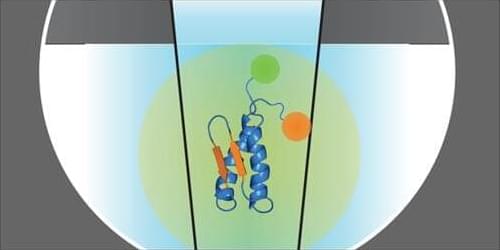
High-temporal-resolution fluorescence measurements reveal how quickly proteins cross energy barriers separating unfolded and folded states.
Proteins are the active molecules of life. To carry out their functions, they adopt specific structures, or “folds.” Biophysicists have long been fascinated by the “protein-folding problem”: How does the sequence of amino-acid building blocks encode the protein’s ultimate fold, and how can folding occur so quickly and reliably? The folding process can be understood as a diffusive random walk through the large space of possible configurations, culminating in the crossing of an energy barrier to reach the folded state. The time spent exploring unfolded configurations can span many orders of magnitude and has been measured with various experimental techniques. By contrast, the comparatively short time to ultimately cross the energy barrier—known as the transition-path time—had never been measured in a naturally occurring protein under biologically relevant conditions.