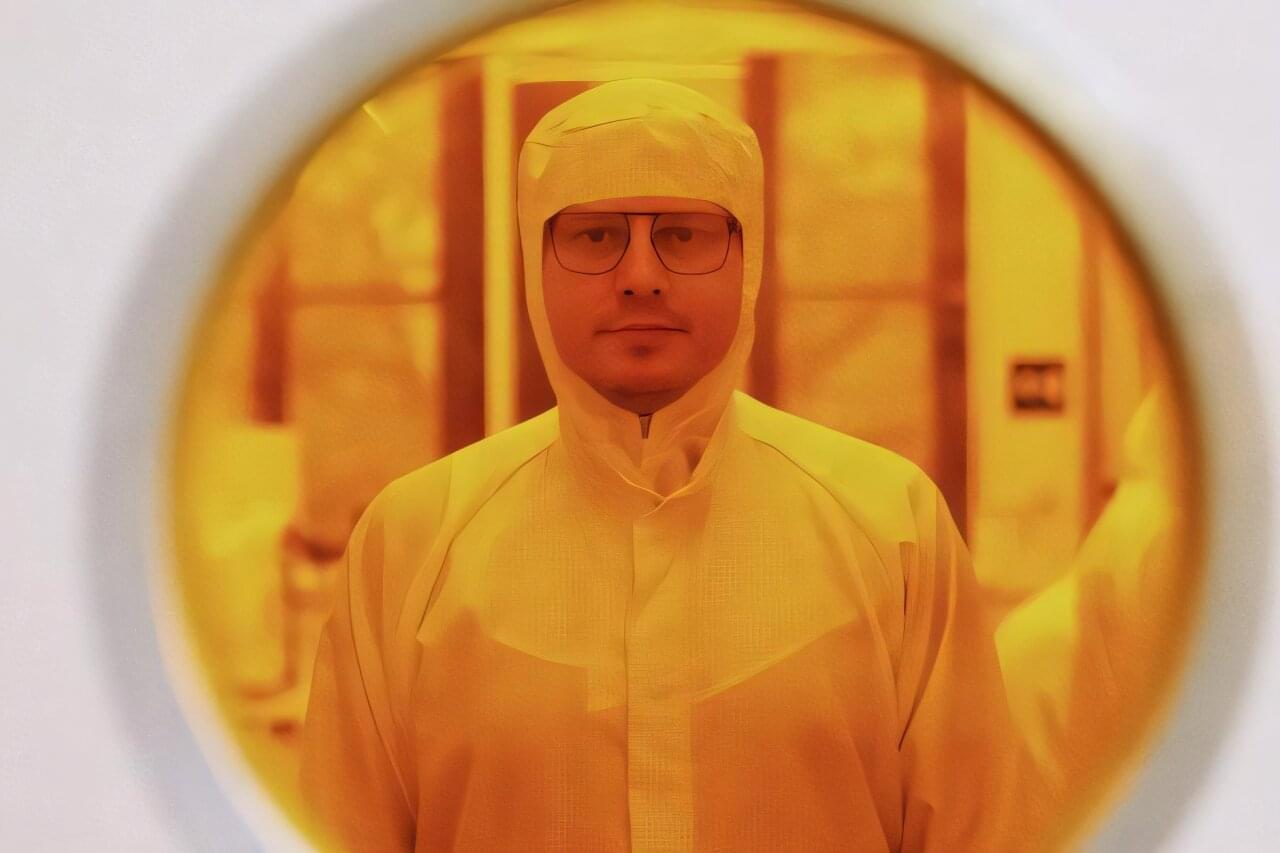
An international team of researchers built a highly sensitive quantum microscope and used it to directly observe, for the first time at room temperature, how electrons subtly interact with each other in graphene—confirming a decades-old theoretical prediction with remarkable precision. The research is published in the journal Nano Letters. The team was led by Dmitri Efetov, Professor of Experimental Solid State Physics at LMU München’s Faculty of Physics and MCQST co-coordinator for Research Area Quantum Matter.
In recent years, “moiré materials”—atomically thin, two-dimensional layered structures such as graphene—have emerged as one of the most exciting frontiers in condensed matter physics. By stacking these atomic layers with a slight rotational misalignment, researchers create interference patterns that fundamentally reshape how electrons move. This simple twist can unlock entirely new quantum phases, including superconductivity and correlated insulating states, making moiré systems a powerful platform for exploring emergent physical phenomena.
Studying these systems, however, has traditionally come with significant technical hurdles. Conventional devices must be assembled with extreme precision, relying on fixed twist angles, painstakingly assembled with precision often better than a tenth of a degree. Even then, imperfections such as strain and disorder can obscure the underlying physics.