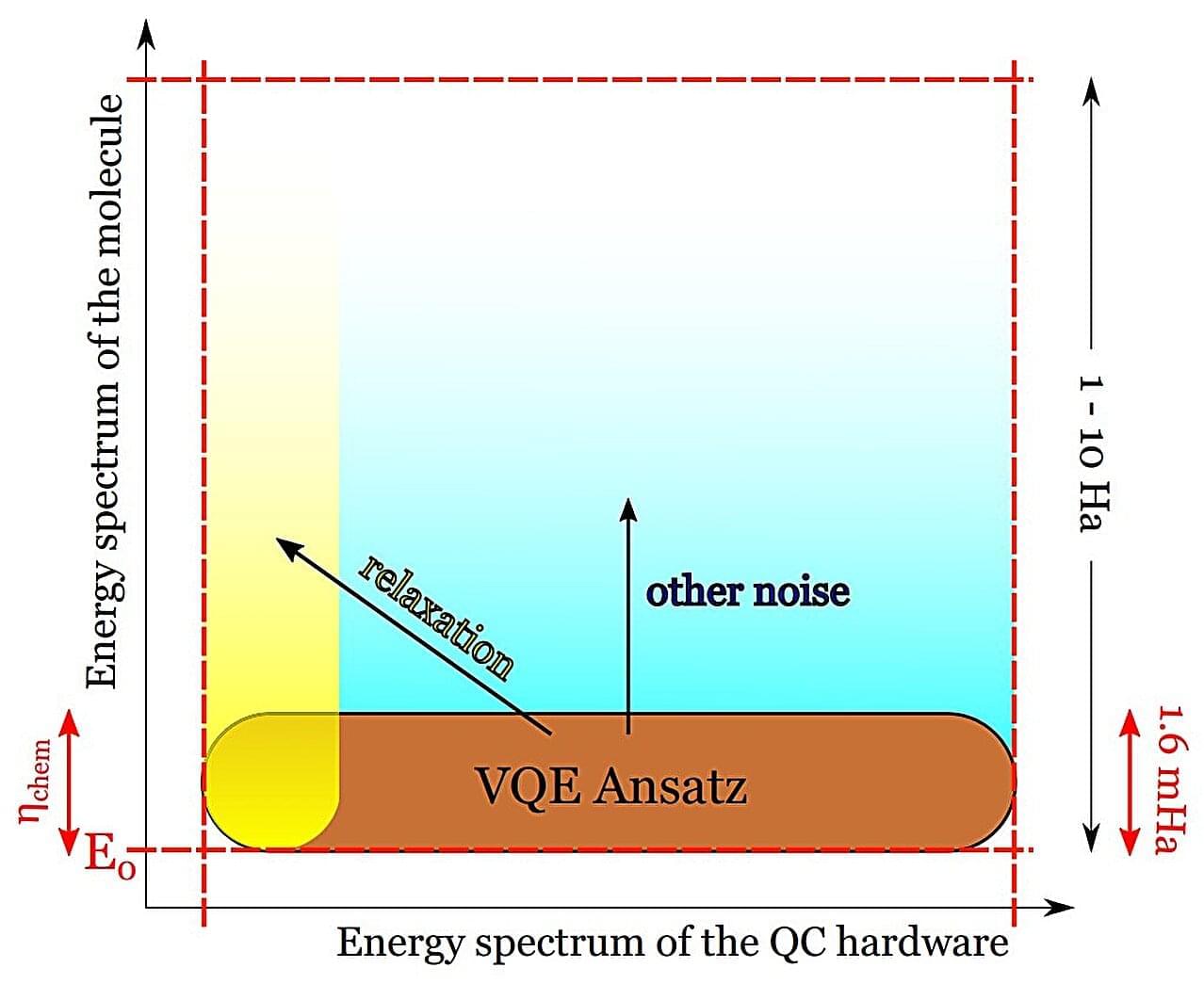
Although the potential applications of quantum computing are widespread, a new feasibility study suggests quantum computers still face major hurdles in solving quantum chemistry problems. The study, published in Physical Review B, evaluates what criteria are needed for a quantum advantage in searching for the ground state energy of molecules. The researchers attempt this feat using two different algorithms with differing strengths and weaknesses.
The team first determined the criteria for the variational quantum eigensolver (VQE) algorithm, which is used for noisy, near-term devices and sets an upper bound to the level of imprecision or decoherence in quantum hardware. The researchers derived quantitative criteria for VQE and QPE based on error rates, energy scales, and overlap with the ground state.
Results showed that VQE is extremely sensitive to hardware errors and decoherence. The team says that achieving chemical accuracy would require error rates far below current hardware capabilities. Available error mitigation techniques offer only limited improvement and scale poorly with system size.