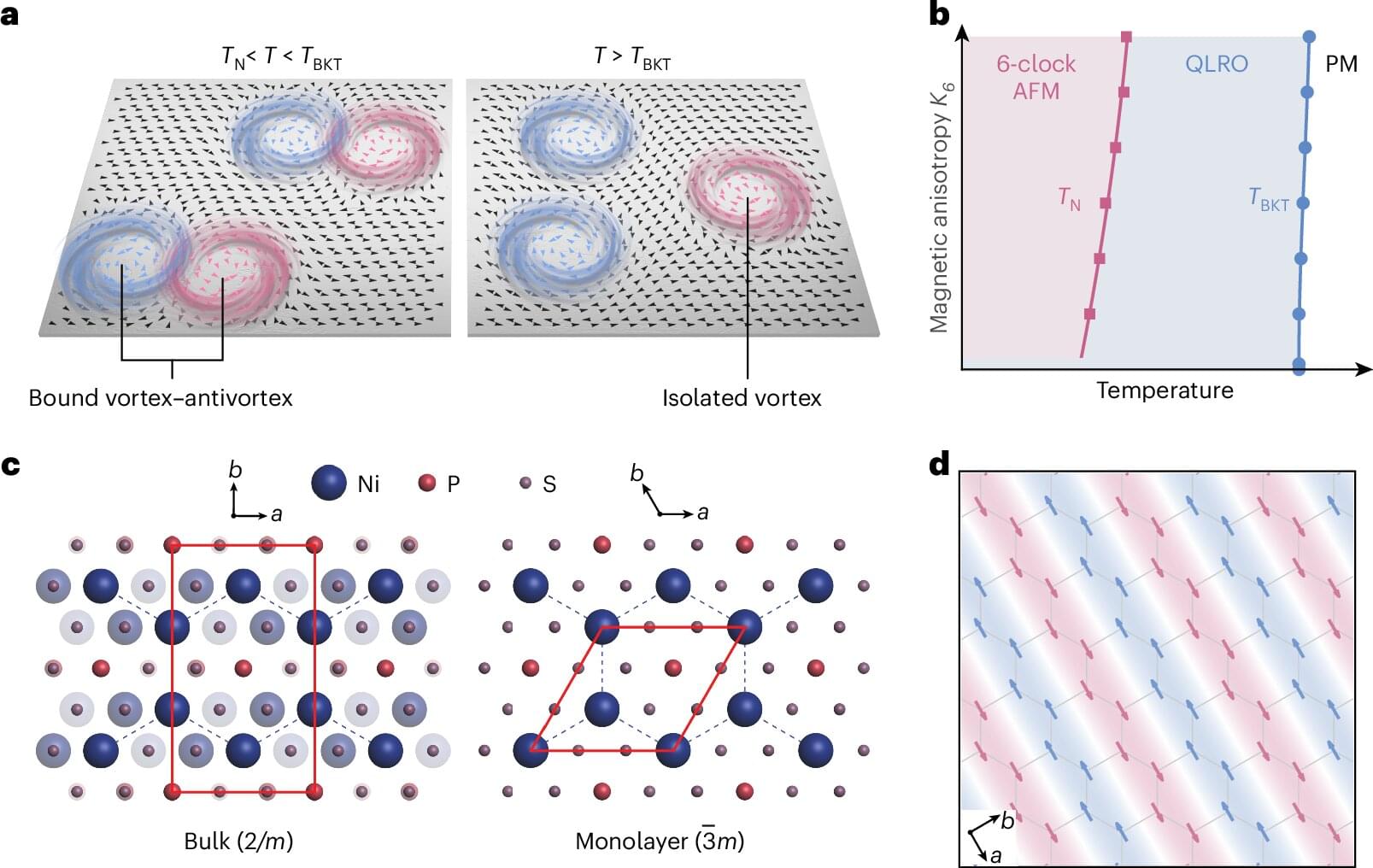
Strange things happen to materials when you peel them down, layer by layer, from thick chunks all the way to sheets just an atom thick. Reporting in the journal Nature Materials, a team led by physicists at The University of Texas at Austin has experimentally demonstrated a sequence of exotic magnetic phases in an ultrathin material that fully realizes, for the first time, a theoretical model of two-dimensional magnetism first proposed in the 1970s. The researchers say the advance might inspire new ultracompact technologies.
The sequence of exotic magnetic phases involves two key transitions that occur as certain materials cool down towards absolute zero. Both transitions have been observed experimentally on their own before, but never together in a complete sequence.
When the researchers cooled an atomically thin sheet of nickel phosphorus trisulfide (NiPS3) to temperatures between −150 and −130° C, the material entered the first special magnetic phase, called a Berezinskii–Kosterlitz–Thouless (BKT) phase. In this regime, the magnetic orientations associated with individual atoms in the material—known as magnetic moments—form swirling patterns called vortices. Pairs of these vortices wind in opposite directions, one clockwise and the other counterclockwise, and remain tightly bound together.