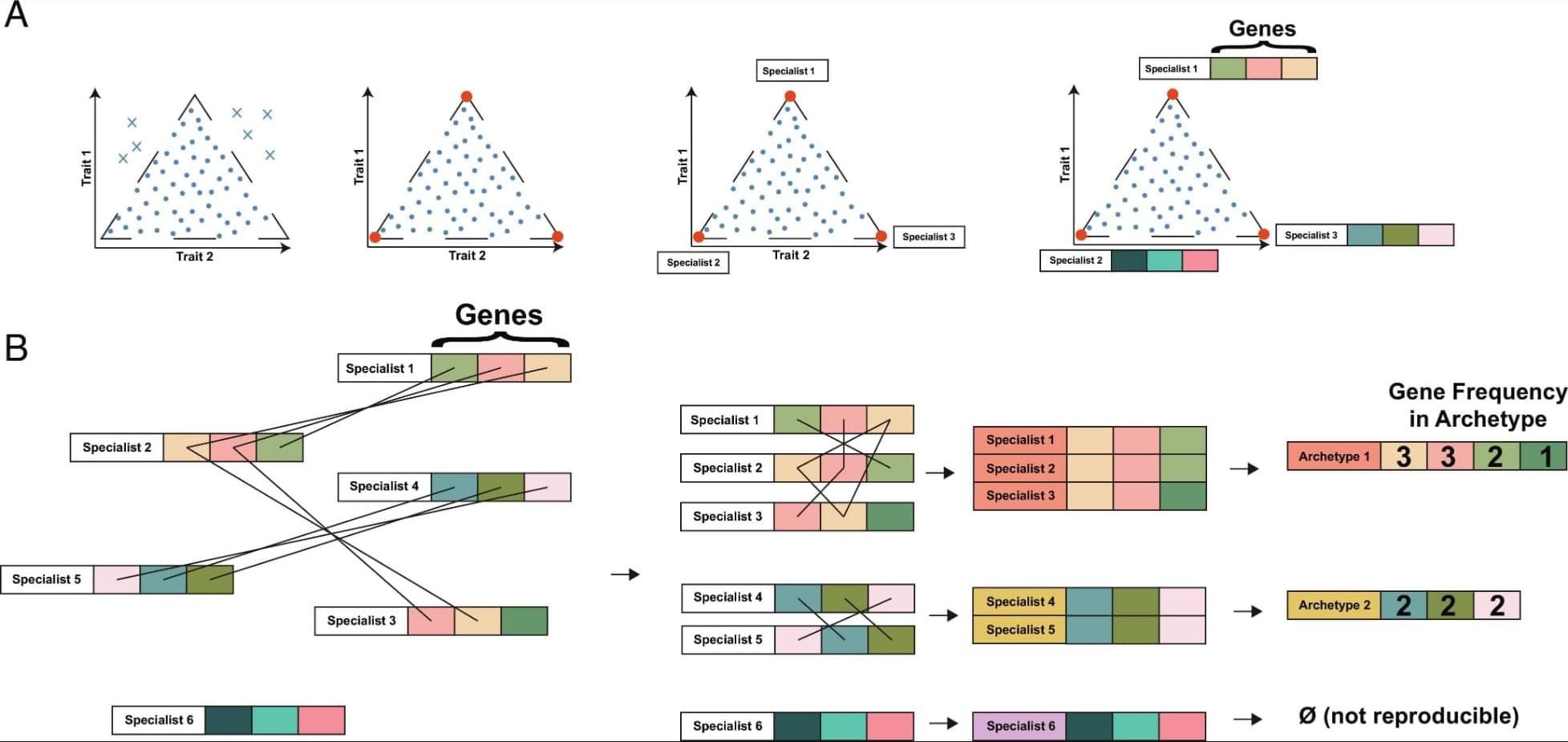
This pattern is the signature of Pareto optimality, a mathematical concept describing how competing objectives create a “frontier” of optimal solutions. Just as you can’t make a car both maximally fast and maximally fuel-efficient without compromise, cells can’t simultaneously optimize all biological functions. A cell might specialize in energy production, defense, or growth—but rarely all three equally.
We hypothesized that the phenotypic variation within cell types is explained by multiobjective optimization and used Tabula Sapiens to test this hypothesis. The Tabula Sapiens Atlas v1 is a single-cell RNA sequencing dataset containing 456,101 high-quality single cell transcriptomes processed via droplet microfluidic emulsion, covering 58,870 genes across 174 cell types, 25 tissues, and 15 donors (16). We applied quality control filters to remove outlier cells on several metrics, yielding 309,193 cells across 173 cell types, 24 tissues, and 14 donors, SI Appendix, Fig. S1 and Table S1. Cell type abundance filters left 110 cell types across the same number of tissues and donors, yielding 440 distinct donor-tissue-cell type strata for analysis (15, 17).
The only assumption we make in this analysis is that fitness is an increasing function of performance (14). Then, if there is a trade-off in performing multiple tasks, optimal phenotypes (i.e., those that maximize fitness) must lie in a region described by convex combinations of points that each maximize a single task’s performance (14). This region is called the Pareto front. Any pruning mechanism that removes nonoptimal phenotypes would restrict observed phenotypes to the Pareto front; pruning is a pervasive strategy across biology, and there could be a host of pruning mechanisms in multicellular organisms.
This approach does not require any assumptions about underlying regulatory dynamics or interactions among units. The Pareto front simply describes the region of optimal phenotypes, and its vertices are phenotypes each optimal at some task. Etiology and underlying regulatory dynamics can shape the Pareto front, but do not contradict that optimal phenotypes must lie on it (18). The elegance and power of Pareto optimality are that no specific selection mechanism or regulatory dynamics are required to arrive at its conclusions.