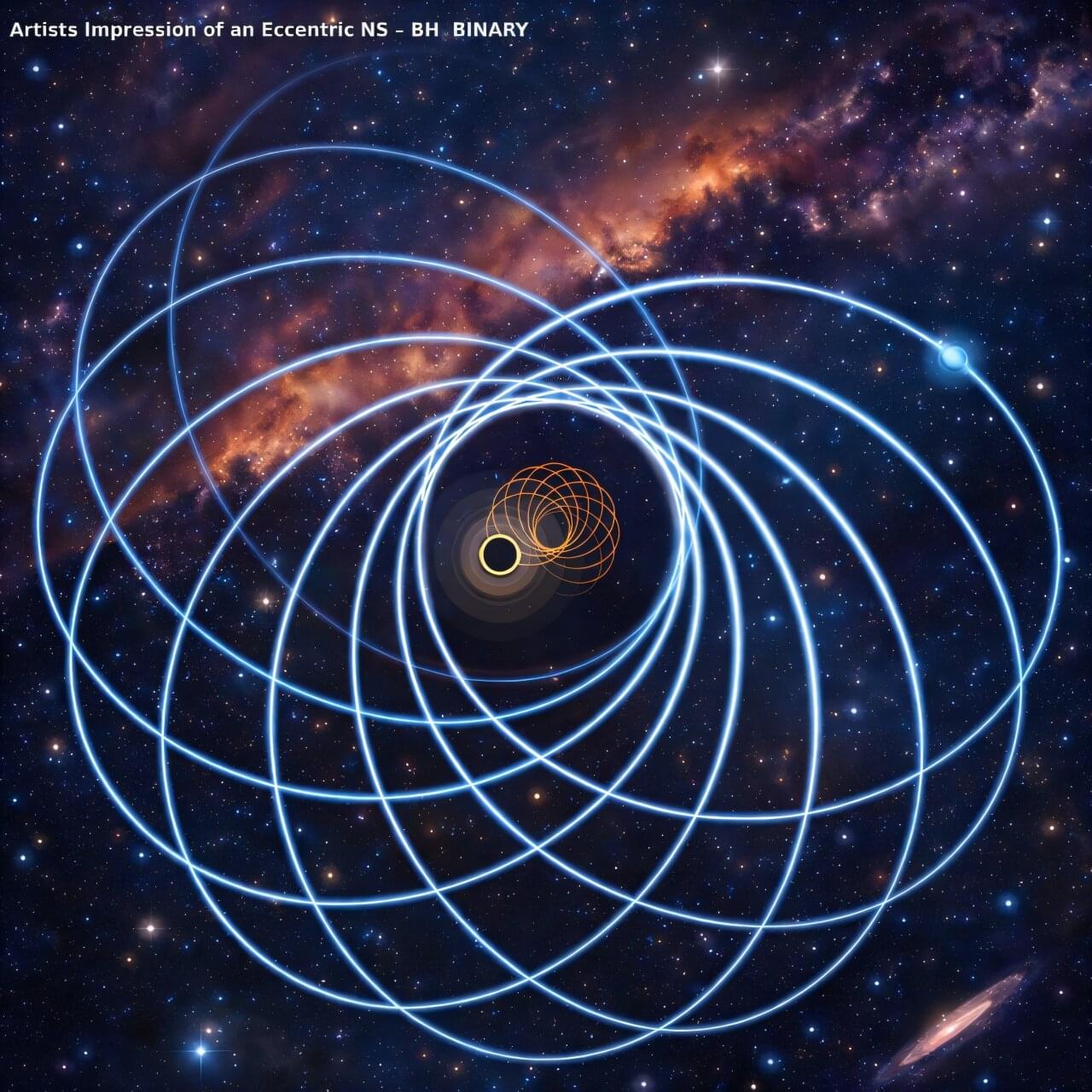
Scientists have uncovered the first robust evidence of a black hole and neutron star crashing together but orbiting in an oval path rather than a perfect circle just before they merged. This discovery challenges long-standing assumptions about how these cosmic pairs form and evolve.
Researchers from the University of Birmingham, Universidad Autónoma de Madrid, and Max Planck Institute for Gravitational Physics published their findings today (11 Mar) in The Astrophysical Journal Letters.
Most neutron star-black hole pairs are expected to adopt circular orbits long before merging. But the analysis of the gravitational-wave event GW200105 shows that this system traveled on an oval orbit long before merging to form a black hole 13 times more massive than the sun. An oval orbit is something never seen before in this kind of collision.