Quantum computers, systems that process information leveraging quantum mechanical effects, could outperform classical computers on some computationally demanding tasks. Despite their potential, as the size of quantum computers increases, reliably describing and measuring the states driving their functioning becomes increasingly difficult.
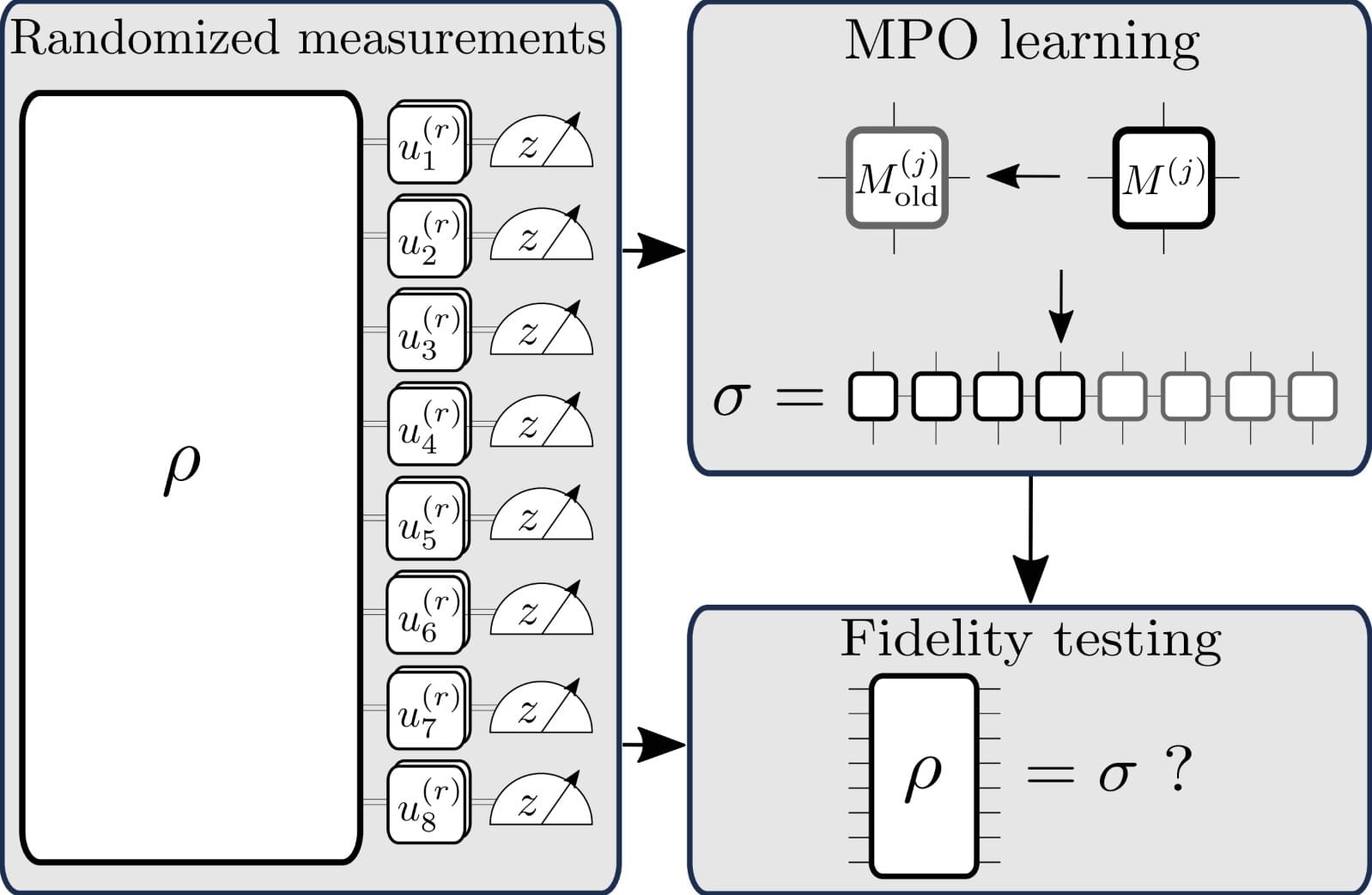
One mathematical approach to simplify the description of quantum systems entails the use of matrix-product operators (MPOs). These are mathematical representations that allow researchers to break down very large systems into a long chain of connected smaller pieces.
Researchers at Université Grenoble Alpes, Technical University of Munich, Max Planck Institute of Quantum Optics, University of Innsbruck and University of Bologna recently developed a new protocol that could be used to learn the MPO representations of quantum states in real, large-scale quantum experiments. Their protocol, presented in a paper published in Physical Review Letters, has so far been found to reliably reconstruct states in quantum systems including up to 96 qubits.