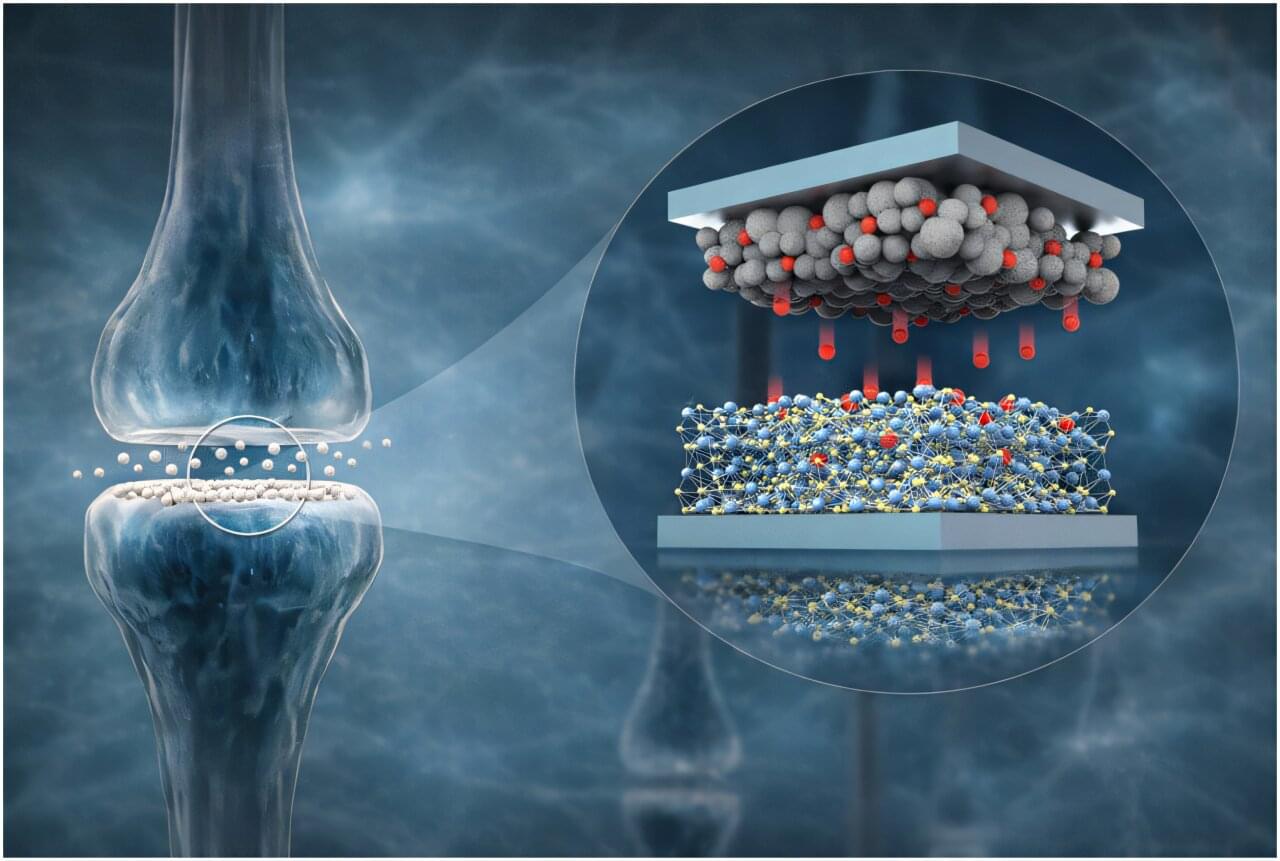
A research team led by Lee Hyun Jun and Noh Hee Yeon from the Division of Nanotechnology at DGIST has succeeded in implementing the world’s first two-terminal-based artificial intelligence (AI) semiconductor that precisely controls hydrogen with electrical signals to enable self-learning and memory. The team’s work appears in Advanced Science.
Whereas modern AI requires the rapid processing of vast amounts of data, the separation of computation and memory in conventional computers results in speed degradation and high power consumption. “Neuromorphic semiconductors,” which perform computation and storage simultaneously by mimicking the human brain, are gaining attention as a next-generation technology that can resolve this problem. At the heart of this semiconductor is an artificial synapse device that changes its conductivity based on electrical signals and maintains that state, and the research team focused on hydrogen as the solution.
Conventional oxide-based memory devices have primarily utilized the migration of oxygen vacancies (defects) as memory. However, this has made it difficult to ensure long-term stability and uniformity between devices. In contrast, the research team solved this problem by developing its own method to precisely control the injection and discharge of hydrogen ions (H+) using an electric field.