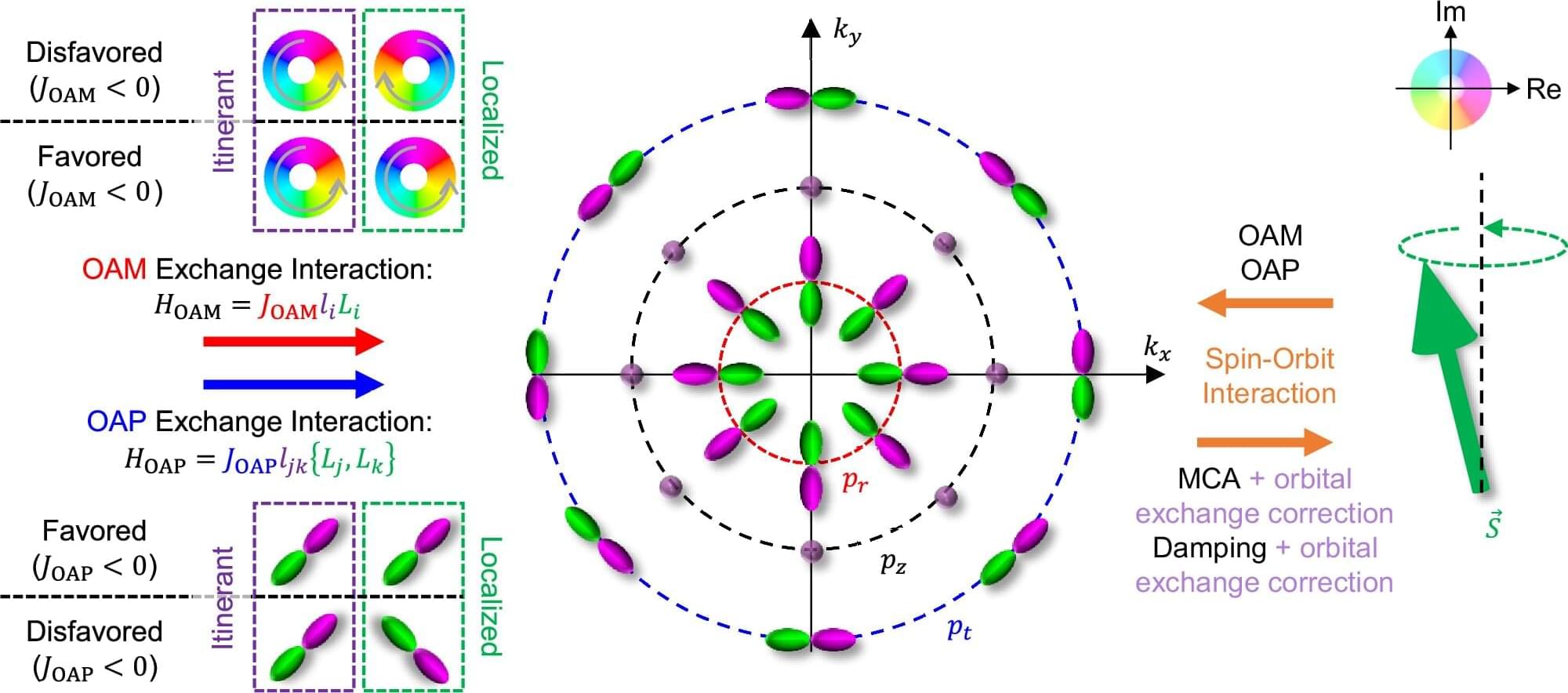
Research is actively underway to develop a “dream memory” that can reduce heat generation in smartphones and laptops while delivering faster performance and lower power consumption. Korean researchers propose a new possibility for controlling magnetism using the exchange interaction of electron orbitals—the motion of electrons orbiting around an atomic nucleus—rather than relying on the conventional exchange interaction of electron spin, the rotational property of electrons inside semiconductors.
A joint research team led by Professor Kyung-Jin Lee of the Department of Physics at KAIST and Professor Kyoung-Whan Kim of the Department of Physics at Yonsei University has established, for the first time in the world, a new theoretical framework enabling magnetism to be freely controlled through orbital exchange interaction, surpassing the limitations of conventional technologies that control magnetism using electric currents. The study is published in the journal Nature Communications.
Until now, next-generation memory research has mainly focused on the spin of electrons. Spin refers to the property of electrons that rotate on their own axis like tiny spinning tops, and information can be stored by using the direction of this rotation. However, electrons simultaneously move around the atomic nucleus along paths known as orbitals.