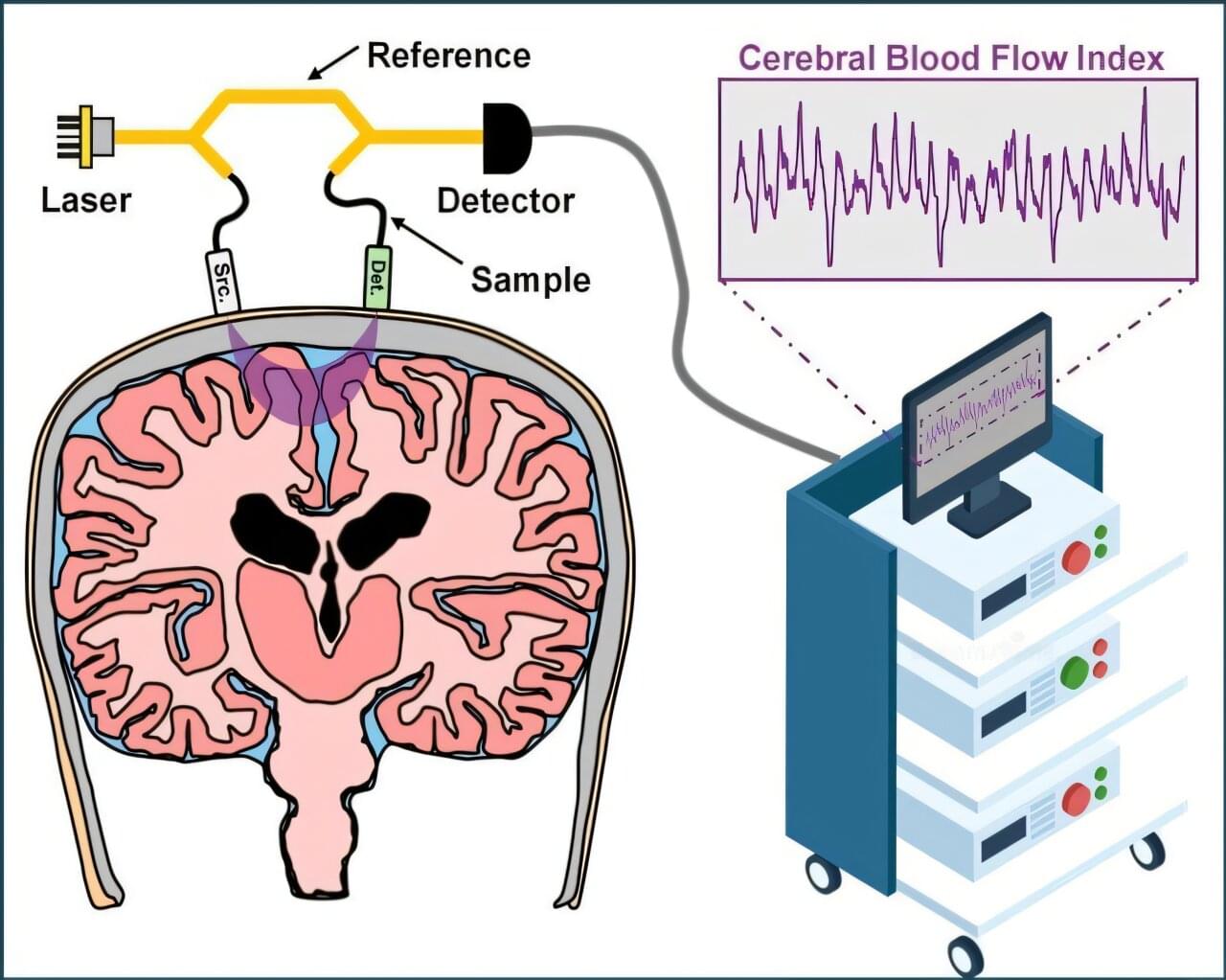
Cerebral blood flow is essential for normal brain function and often perturbed in neurological disease. If one shines a source of coherent light on perfused tissue, the detected speckles, or “grains” of light fluctuate, or “dance,” at a rate proportional to blood flow in the volume sampled by the light. In brain tissue, this concept can be harnessed to measure the cerebral blood flow index (CBFi).
However, to date, implementations of this principle for noninvasive adult human brain monitoring—collectively known as diffuse correlation spectroscopy (DCS)—have achieved limited brain sensitivity. This is because the brain is 1–2 centimeters deep beneath the scalp and skull, meaning that the light must sample the superficial tissue before reaching the brain.
While the collection points can be moved further from the source to address this issue by improving sampling of the brain, this strategy requires many photon-counting channels to detect highly attenuated light far from the source. DCS becomes prohibitively expensive as the number of channels increases.