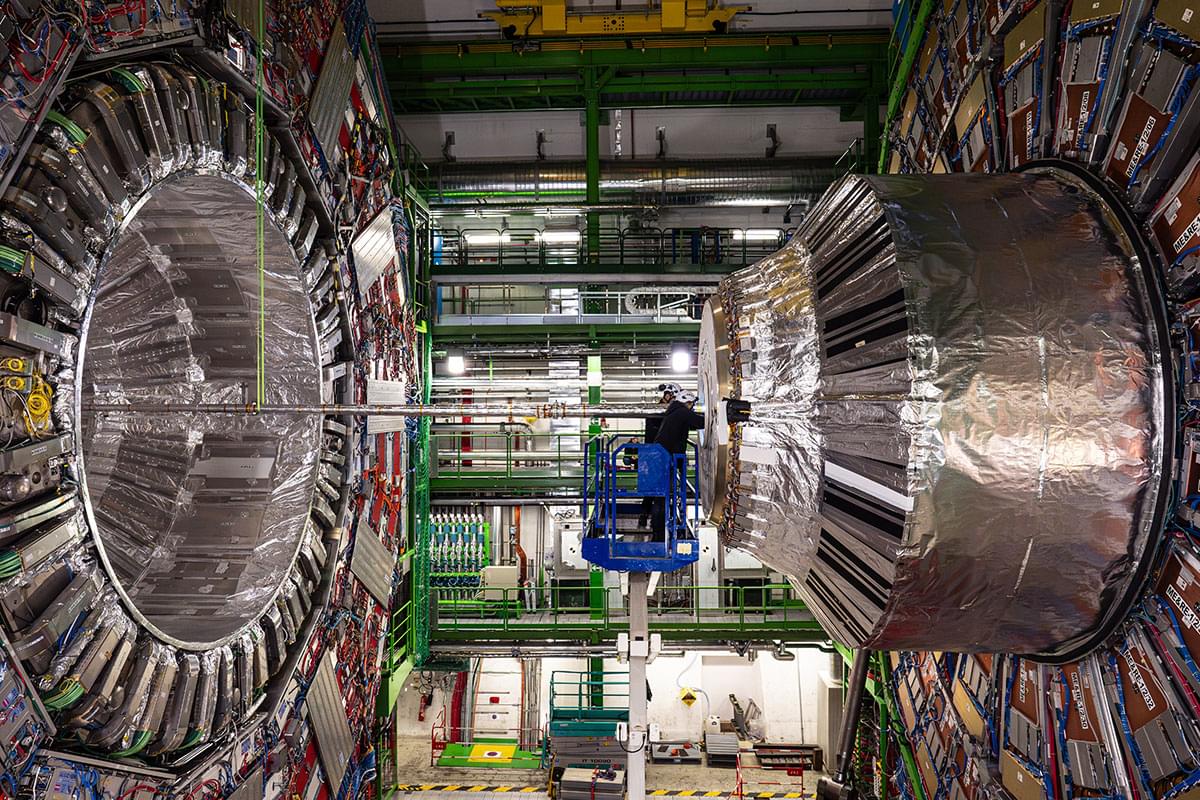
The CMS experiment at CERN is building a new detector that will unravel the chaotic particle collisions at the Large Hadron Collider, helping scientists identify particles based on their speeds.
What if Olympic officials could record sprinters’ times only to the nearest minute? “We would know who started the race, and who finished the race, but that’s it,” said Bryan Cardwell, a postdoctoral researcher at the University of Virginia. “There’s no way to know who arrived first and who arrived last.”
Cardwell and his colleagues on the CMS experiment are currently tackling a similar problem. The CMS experiment records the tracks and properties of subatomic particles created by the Large Hadron Collider, the world’s most powerful particle accelerator. As it stands, physicists get a picture of all the particles produced in a collision, but they have insufficiently detailed information about when the particles were produced or how fast they were traveling, making it difficult to tell them apart.