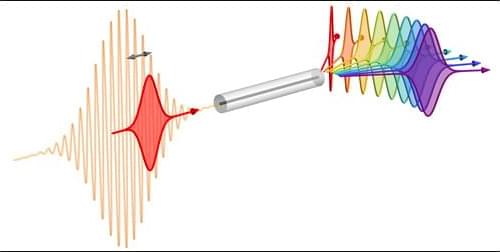
Researchers can adjust the frequency and bandwidth of single photons inside an optical fiber, which will be useful for future quantum networks.
Future quantum technologies will require practical techniques for adjusting the frequencies and bandwidths of individual photons to optimize them for various purposes without losing the delicate quantum data that they carry. Now researchers have improved on previous technology and have shown how both properties can be tuned over a wide range inside a short length of standard optical fiber [1]. They expect that this technique will be more practical and effective than current alternatives and will find wide use in interfacing devices in future quantum computing and communications networks.
Photons are likely to provide the means for transmitting information within future quantum networks, but frequent changes to their properties will be required in order for them to carry out a diversity of tasks. For example, a trapped-ion quantum memory emits or absorbs photons at a specific visible wavelength with an extremely narrow bandwidth, which means that a photon with which it interacts must be produced as a relatively long light pulse. In contrast, a high-speed fiber-optic channel works best with infrared photons having much broader bandwidths, which require short light pulses.