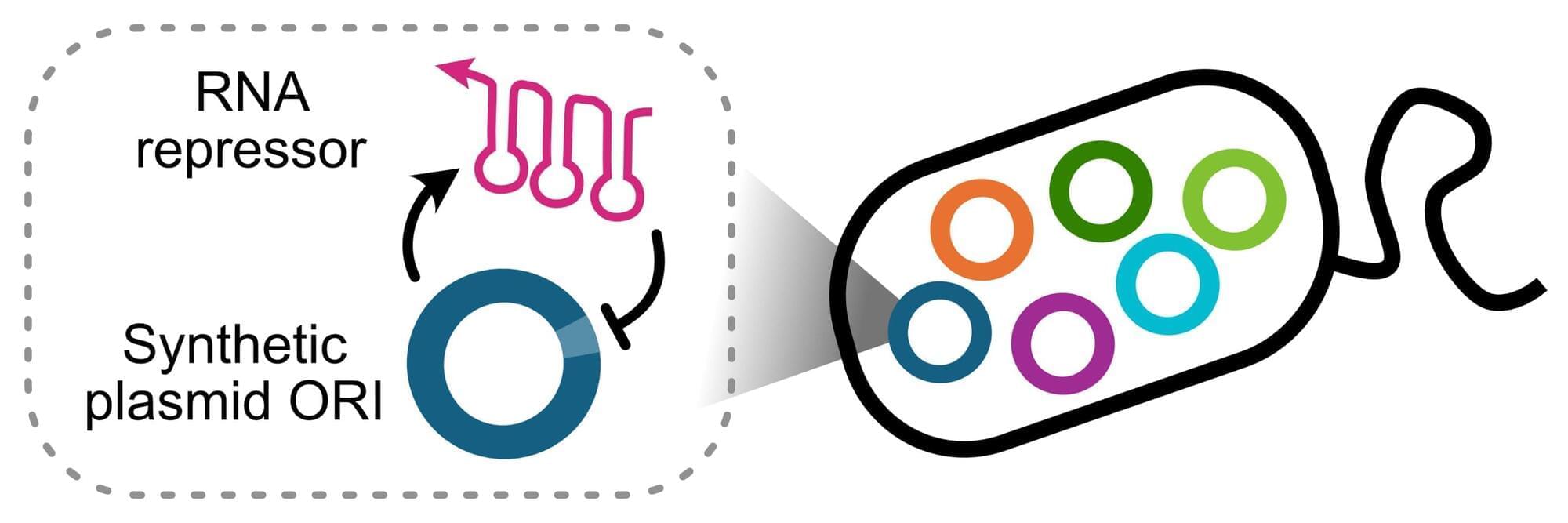
“If it ain’t broke, don’t fix it,” goes the old adage, which Rice University professor James Chappell completely ignored in a recent Nature Communications publication. In the study, Chappell describes an innovation in plasmids, circular pieces of DNA that have been a workhorse of molecular biology research since the 1970s.
“For decades, we’ve been designing experiments around two major limitations of plasmids: fixed copy numbers and incompatibility,” said Chappell, the corresponding author on the study. “While functional, such workarounds are clunky. We created a synthetic version of a part of the plasmid called the origin of replication that allows us to modify the plasmid instead of modifying the experiment.”
Plasmids are typically put into bacterial cells, where they use the cell’s machinery to build proteins and create copies of themselves. Each plasmid generates tiny pieces of a stop signal, called a negative regulator, which binds to the origin of replication (ORI).