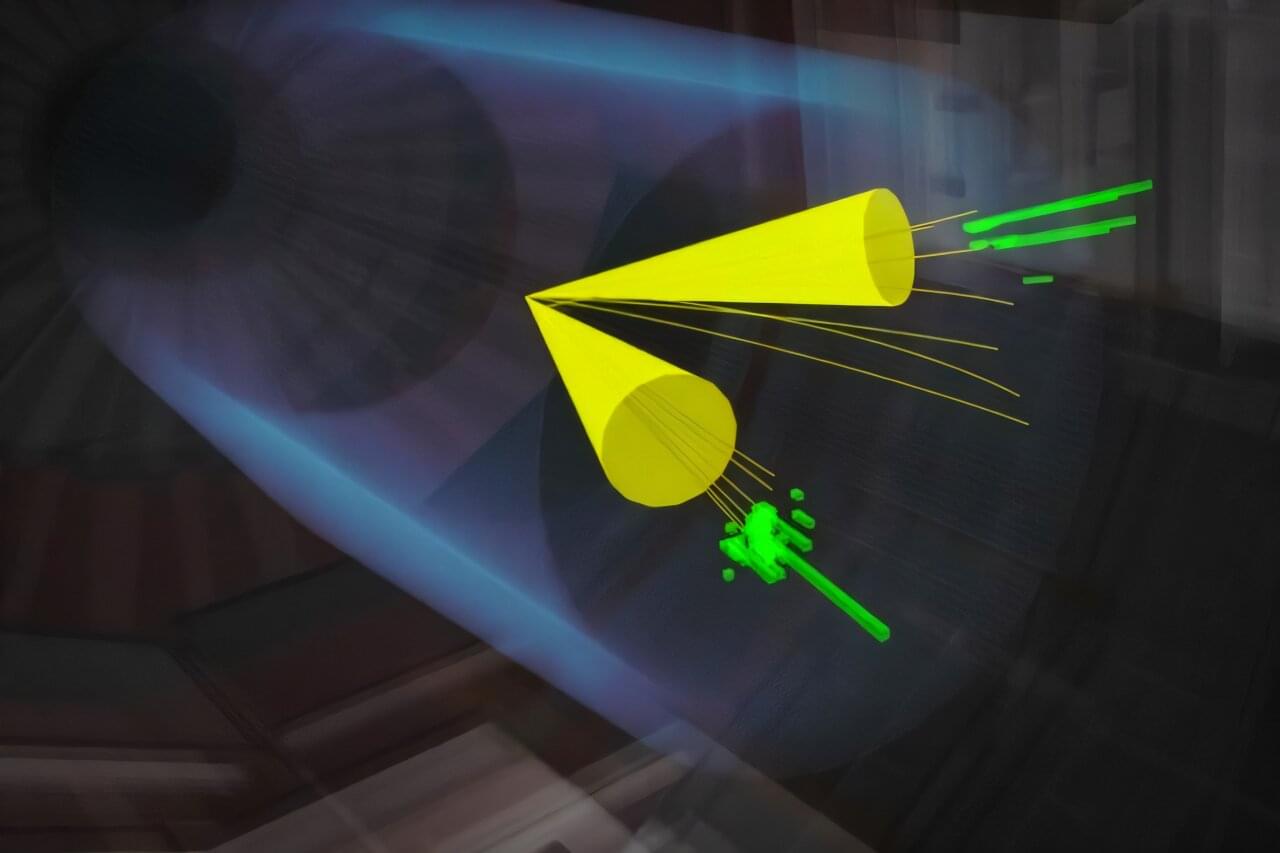
Particle accelerators reveal the heart of nuclear matter by smashing together atoms at close to the speed of light. The high-energy collisions produce a shower of subatomic fragments that scientists can then study to reconstruct the core building blocks of matter.
An MIT-led team has now used the world’s most powerful particle accelerator to discover new properties of matter, through particles’ “near-misses.” The approach has turned the particle accelerator into a new kind of microscope—and led to the discovery of new behavior in the forces that hold matter together.
In a study appearing this week in the journal Physical Review Letters, the team reports results from the Large Hadron Collider (LHC)—a massive underground, ring-shaped accelerator in Geneva, Switzerland. Rather than focus on the accelerator’s particle collisions, the MIT team searched for instances when particles barely glanced by each other.