Over the past decades, electronics engineers have been trying to develop increasingly smaller devices that can store information reliably, even when they are not powered on. A promising type of non-volatile memory device is spintronics, solid-state systems that store and process information leveraging the spin (i.e., an intrinsic form of angular momentum) of electrons.
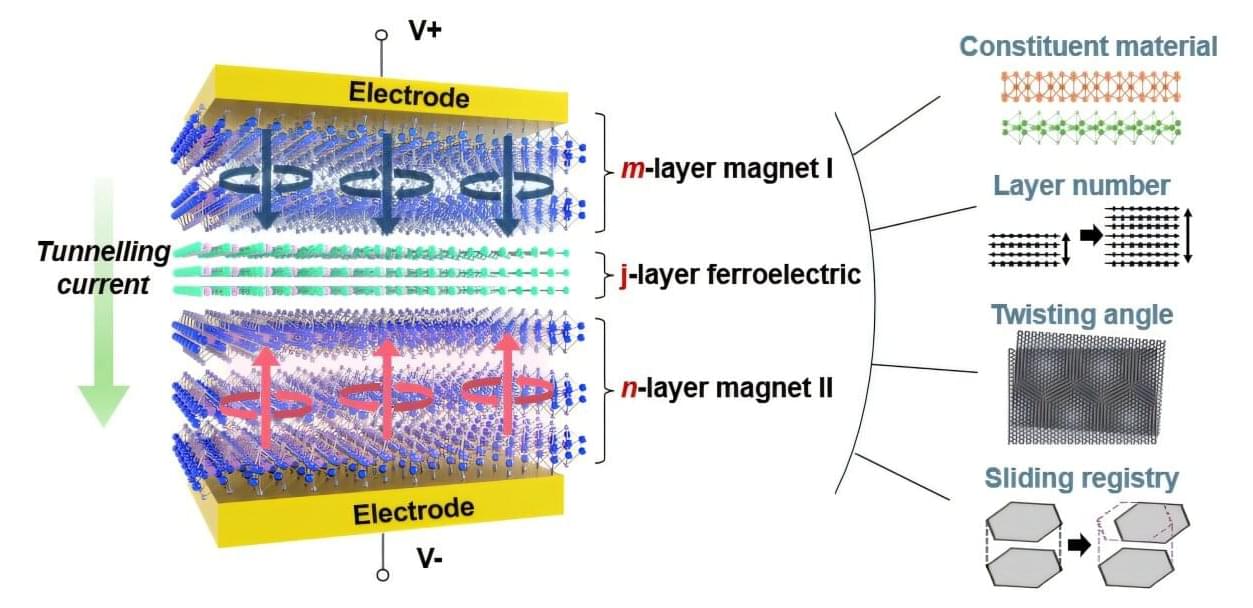
Researchers at University of Maryland and other institutes recently introduced a new spintronic device based on nanoscale structures based on materials that exhibit ferromagnetism (i.e., a permanent yet switchable magnetic order) and ferroelectricity (i.e., a permanent yet switchable electric polarization). This device, presented in a paper published in Nature Nanotechnology, can switch between four stable resistance states and could thus serve as a multistate memory.
The system that was nanoengineered by the researchers combines two different types of devices, known as magnetic tunnel junctions (MTJs) and ferroelectric tunnel junctions (FTJs). An MTJ consists of two magnetic thin films separated by an insulating thin film, while an FTJ is composed of two different metal electrode layers separated by a thin ferroelectric film. Both these types of devices have proved to be promising information storage solutions.