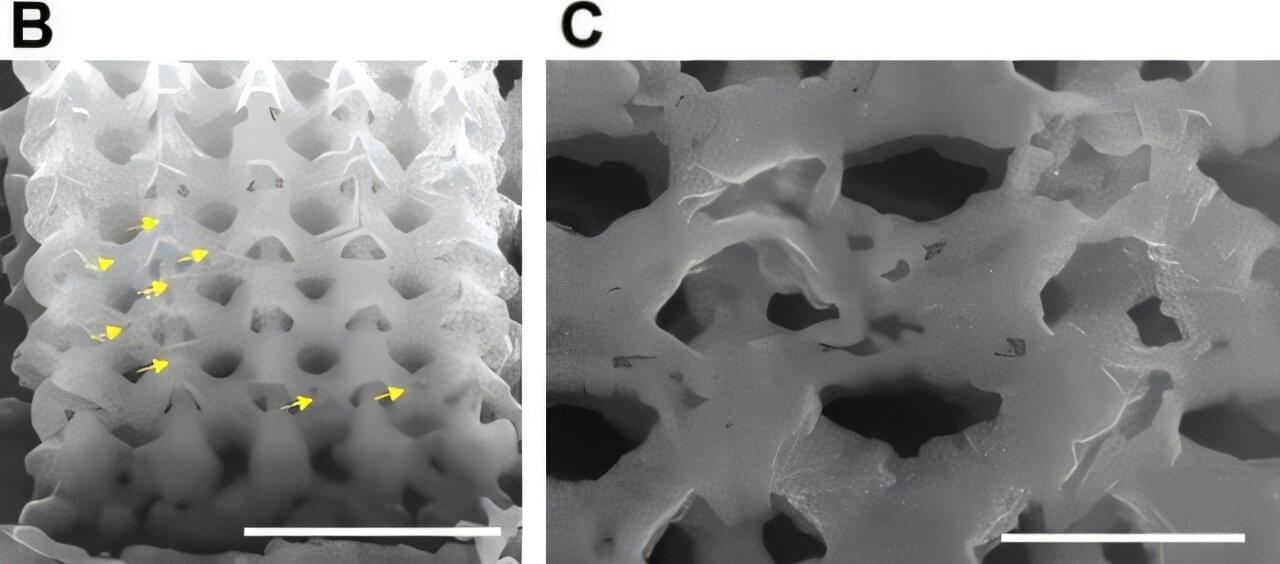
Scientists at Caltech have figured out how to precisely engineer tiny three-dimensional (3D) metallic pieces with nanoscale dimensions. The process can work with any metal or metal alloy and yields components of surprising strength despite having a porous and defect-ridden microstructure, making it potentially useful in a wide range of applications, including medical devices, computer chips, and equipment needed for space missions.
The scientists describe their method in a paper published in the journal Nature Communications. The work was completed in the lab of Julia R. Greer, the Ruben F. and Donna Mettler Professor of Materials Science, Mechanics and Medical Engineering at Caltech, and Huajian Gao of Tsinghua University in Beijing.
The researchers use a technique called two-photon lithography that allows them to sequentially build an object of a desired size and shape by carefully controlling the geometry at the level of individual voxels, the smallest distinguishable volumes, or features, in a 3D image. Beginning with a light-sensitive liquid, the scientists use a tightly focused femtosecond laser beam—a femtosecond is 1 quadrillionth of a second—to build a desired shape out of a gel-like material called hydrogel. After infusing the miniature hydrogel sculpture with metallic salts, such as copper nitrate or nickel nitrate, they heat the structure twice in a specialized furnace to produce a shrunken metallic replica of the original shape.