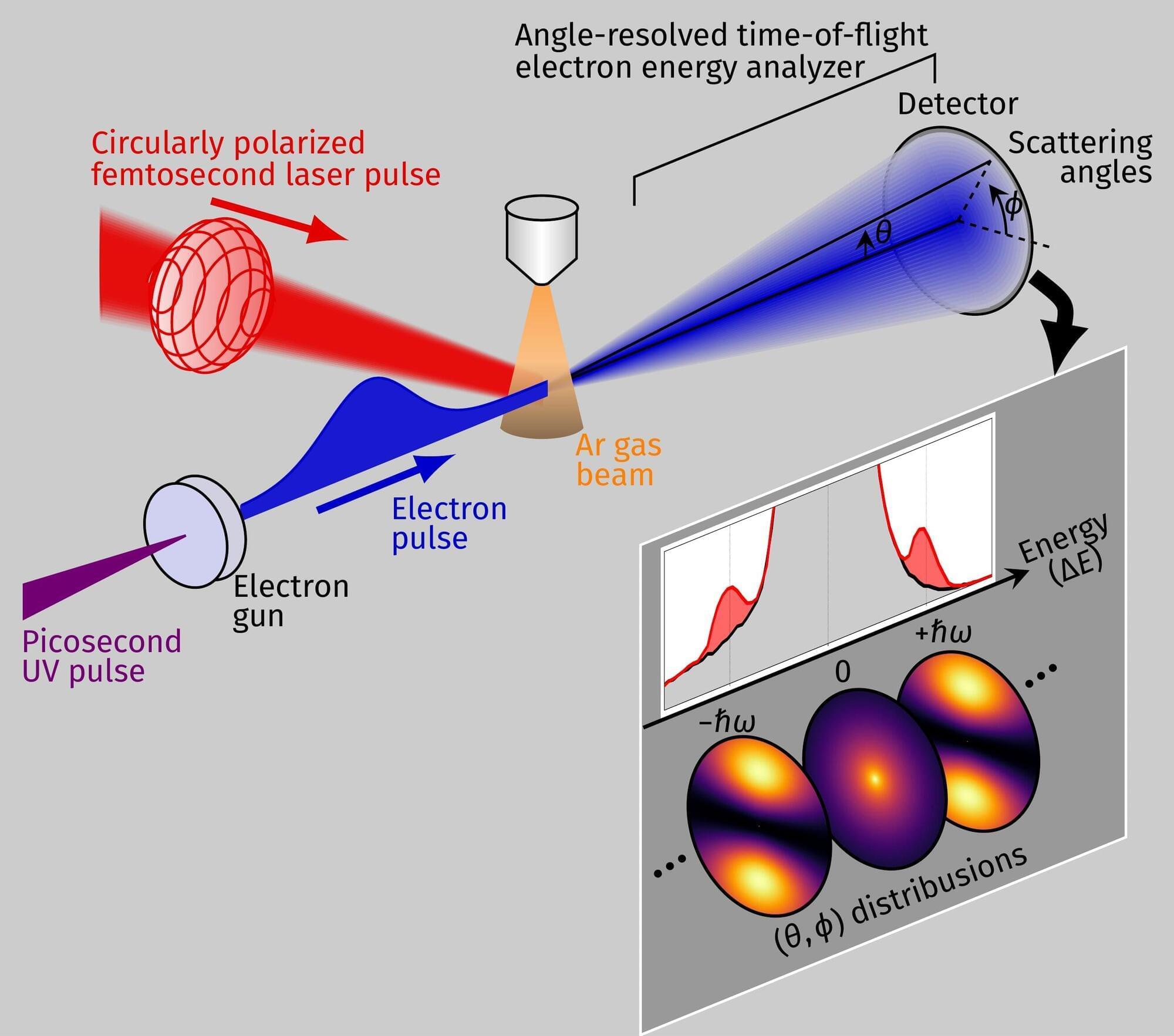
Researchers from Tokyo Metropolitan University have succeeded in detecting laser-assisted electron scattering (LAES) using circularly polarized light for the first time. The use of circularly polarized light promises valuable insights into how atomic scale “helicity” impacts how electrons interact with matter and light.
Using synchronized femtosecond laser pulses and electron pulses directed at argon atoms, they succeeded in detecting a LAES signal showing excellent agreement with theory. The findings are published in The Journal of Chemical Physics.
LAES is a cutting-edge tool for understanding how electrons interact with matter under the influence of strong fields. When electrons are fired at atoms or molecules, they are scattered in all directions; the presence of strong light can change the way in which the scattering takes place due to an exchange of energy with the surrounding light field.