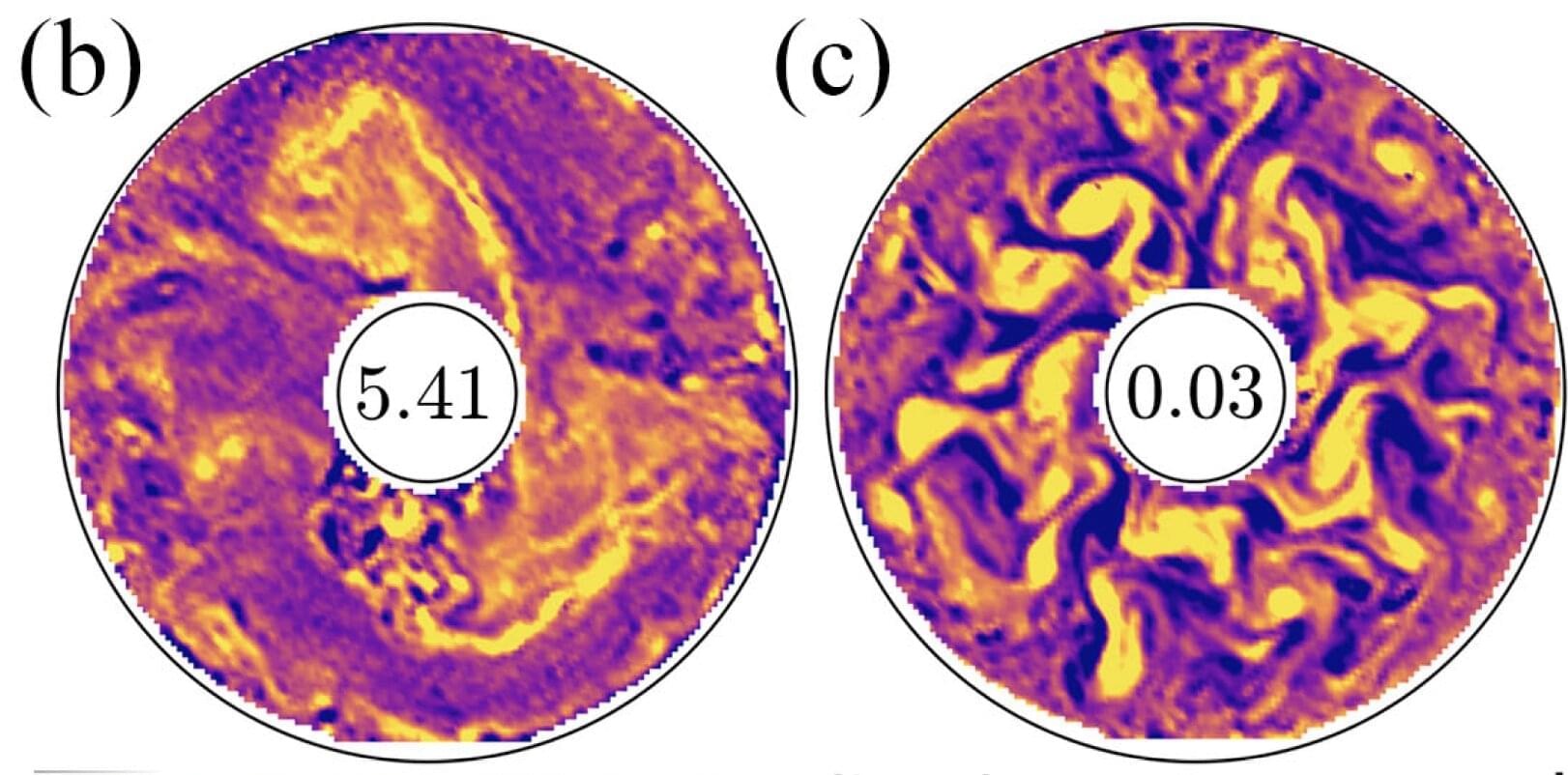
With a new lab-based experiment, researchers in the UK and France have recreated the characteristic cascades of energy and angular momentum that underpin key features of Earth’s atmosphere. Reporting in Physical Review Letters, a team led by Peter Read at the University of Oxford has gained fresh insights into how energy fluctuations in turbulent flows are linked to their size, while also uncovering behaviors that current atmospheric models can’t yet explain.
For all its complexity, many large-scale properties of Earth’s atmosphere can be captured by relatively simple mathematical laws. Among the most important is the “cascade” of energy and rotational motion between flows spanning vastly different scales: from jet streams stretching thousands of kilometers, down to tiny eddies just a few meters across.
This cascade is central to understanding the effect of turbulence. In modern atmospheric theory, there is an inverse relationship between the size of a flow and the kinetic energy contained in its fluctuations, which allows researchers to describe turbulence using a kinetic energy spectrum. This in turn helps climatologists to track how energy is distributed across different length scales.