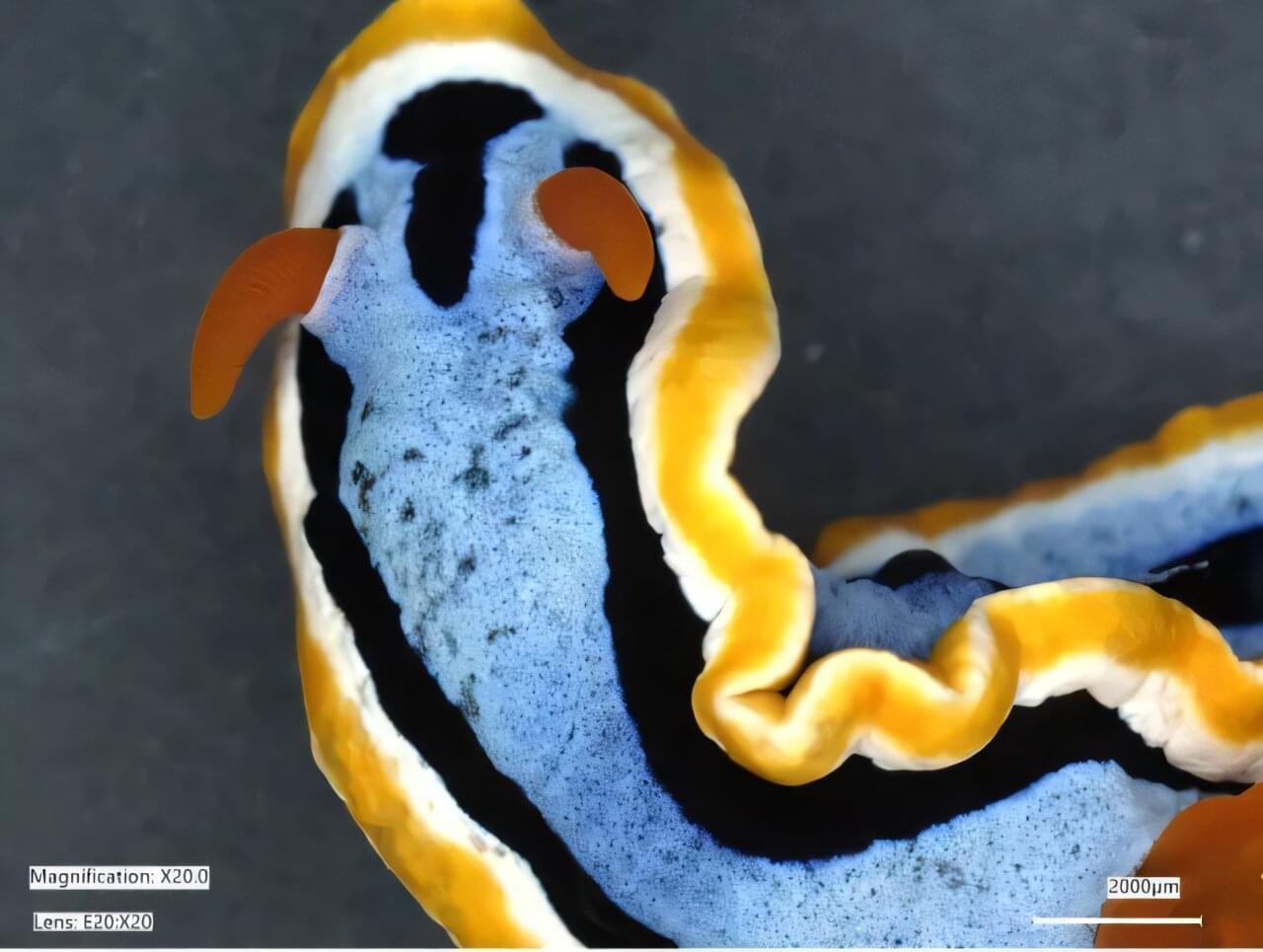
Nudibranchs are often referred to as the butterflies of the sea. Nudibranchs live worldwide, primarily in warm, shallow marine regions, and stand out for their flamboyant colors and diverse shapes. A team from the Max Planck Institute of Colloids and Interfaces in Potsdam and the University of Cambridge has now discovered how they create their colorful patterns. According to their findings, published in the Proceedings of the National Academy of Sciences, the color is produced by nanostructures, each of which creates a specific color impression.
“We were surprised to find that nudibranchs use structural colors,” says Samuel Humphrey, who conducted the research at the Max Planck Institute of Colloids and Interfaces. “Biologists had previously assumed that the colors were produced by pigments.” Pigments are chemical compounds and differently colored pigments have different chemical compositions.
In contrast, in structural colors, color is not a chemical property of the material, but it depends on the length scale of nanostructures composing the material. Such nanostructures, also called photonic crystals, are responsible for the coloration of chameleons, as well as many birds and butterflies. In such structures, color is produced by the regular arrangement of materials with different refractive indices.