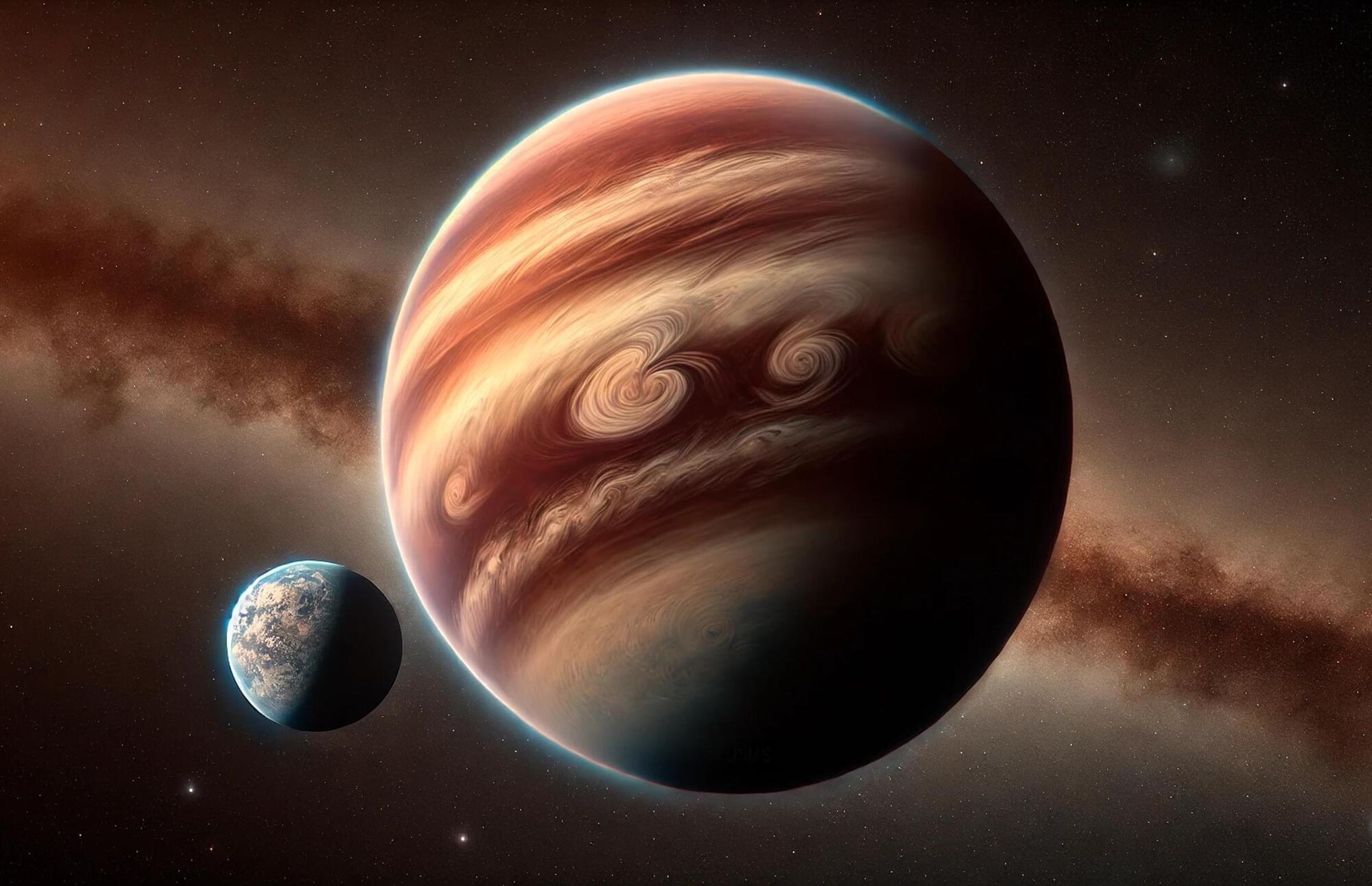
Liquid water is considered essential for life. Surprisingly, however, stable conditions that are conducive to life could exist far from any sun. A research team from the Excellence Cluster ORIGINS at LMU and the Max Planck Institute for Extraterrestrial Physics (MPE) has shown that moons around freefloating planets can keep their water oceans liquid for up to 4.3 billion years by virtue of dense hydrogen atmospheres and tidal heating—that is to say, for almost as long as Earth has existed and sufficient time for complex life to develop.
Planetary systems often form under unstable conditions. If young planets come too close, they can fling each other out of their orbits. This creates free-floating planets (FFPs) that wander through the galaxy without a parent star. An earlier study by LMU physicist Dr. Giulia Roccetti had shown that gas giants ejected in this way do not necessarily lose all of their moons in the process. The new study is published in the Monthly Notices of the Royal Astronomical Society.
Tidal heating keeps oceans liquid The ejection does, however, alter the orbits of the moons. They become highly elliptical, such that their distance from the planet constantly changes. The resulting tidal forces rhythmically deform the lunar body, compress its interior, and generate heat through friction. This tidal heating can be sufficient to maintain oceans of liquid water on the surface—even without the energy of a star, and in the cold of interstellar space.