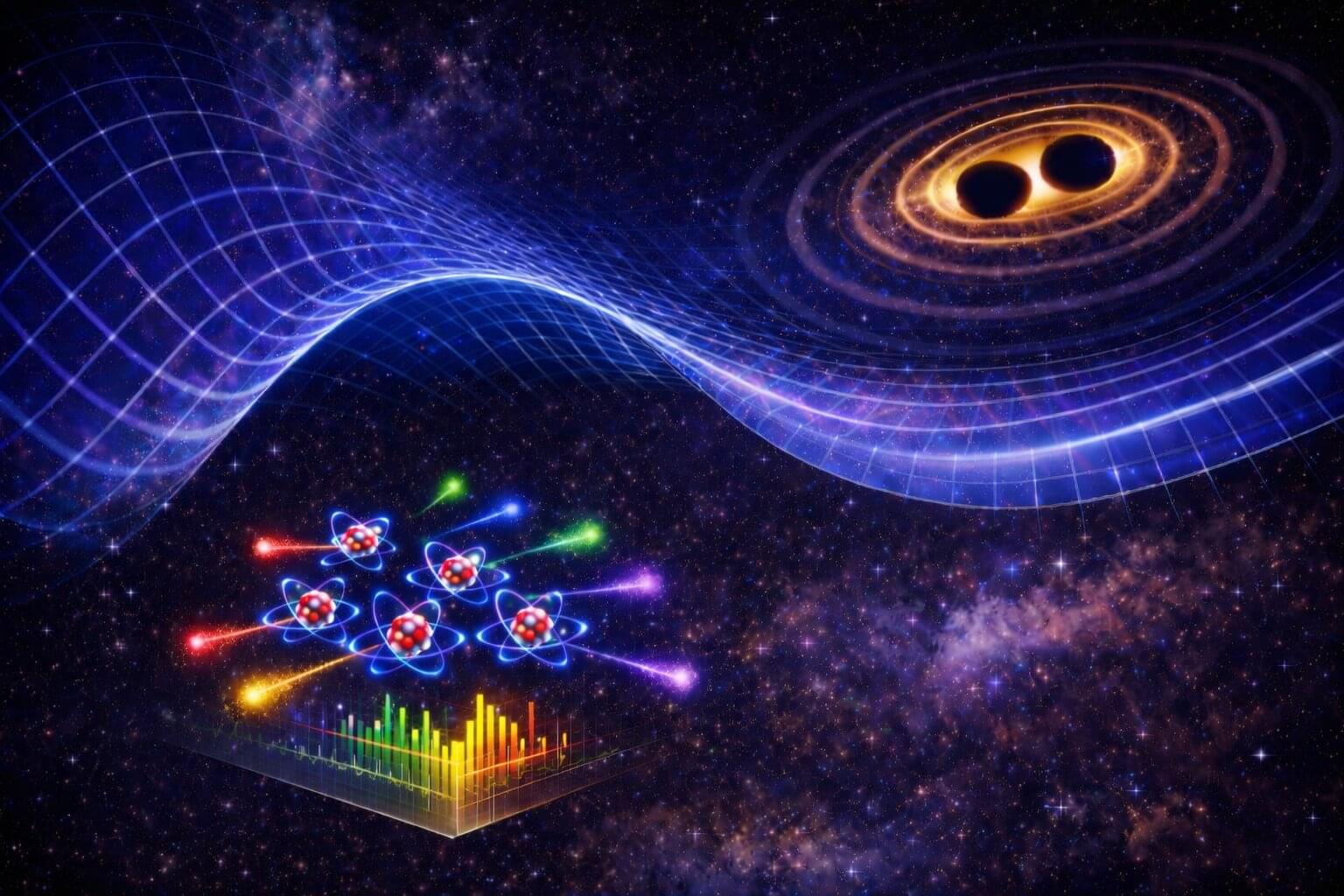
Gravitational waves are ripples in spacetime produced by violent cosmic events, such as the merging of black holes. So far, direct detections have relied on measuring tiny distance changes over kilometer-scale instruments. In a new theoretical study published in Physical Review Letters, researchers at Stockholm University, Nordita, and the University of Tübingen propose an unconventional approach: tracking how gravitational waves reshape the light emitted by atoms. The work describes a possible detection route, but an experimental demonstration remains for the future.
When atoms are excited, they naturally relax by emitting light at a characteristic frequency—a quantum process known as spontaneous emission. This happens through their interaction with the quantum electromagnetic field.
“Gravitational waves modulate the quantum field, which in turn affects spontaneous emission,” said Jerzy Paczos, a Ph.D. student at Stockholm University. “This modulation can shift the frequencies of emitted photons compared with the no-wave case.”