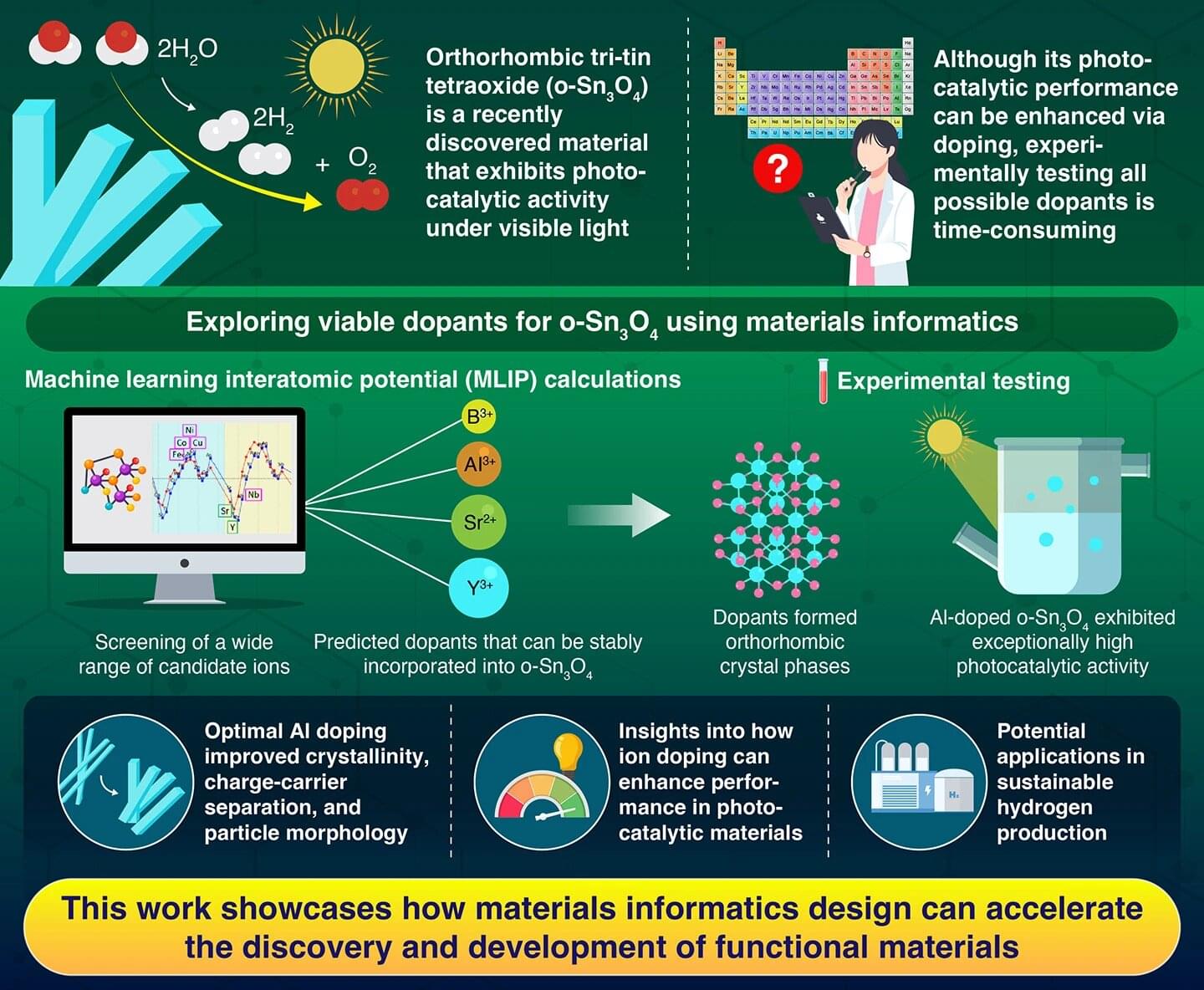
MLIP calculations successfully identify suitable dopants for a novel photocatalytic material, report researchers from the Institute of Science Tokyo. As demonstrated in their study, published in the Journal of the American Chemical Society, a materials informatics approach could predict which ions can be stably introduced into orthorhombic Sn3O4, a promising and recently discovered photocatalytic tin oxide.
Their experiments revealed that aluminum-doped samples achieved 16 times greater hydrogen production than the undoped material, paving the way for next-generation clean energy applications.
Building a sustainable hydrogen economy requires clean and efficient ways to produce hydrogen at scale. One particularly attractive approach is photocatalysis—using materials called photocatalysts to split water into hydrogen and oxygen utilizing sunlight.