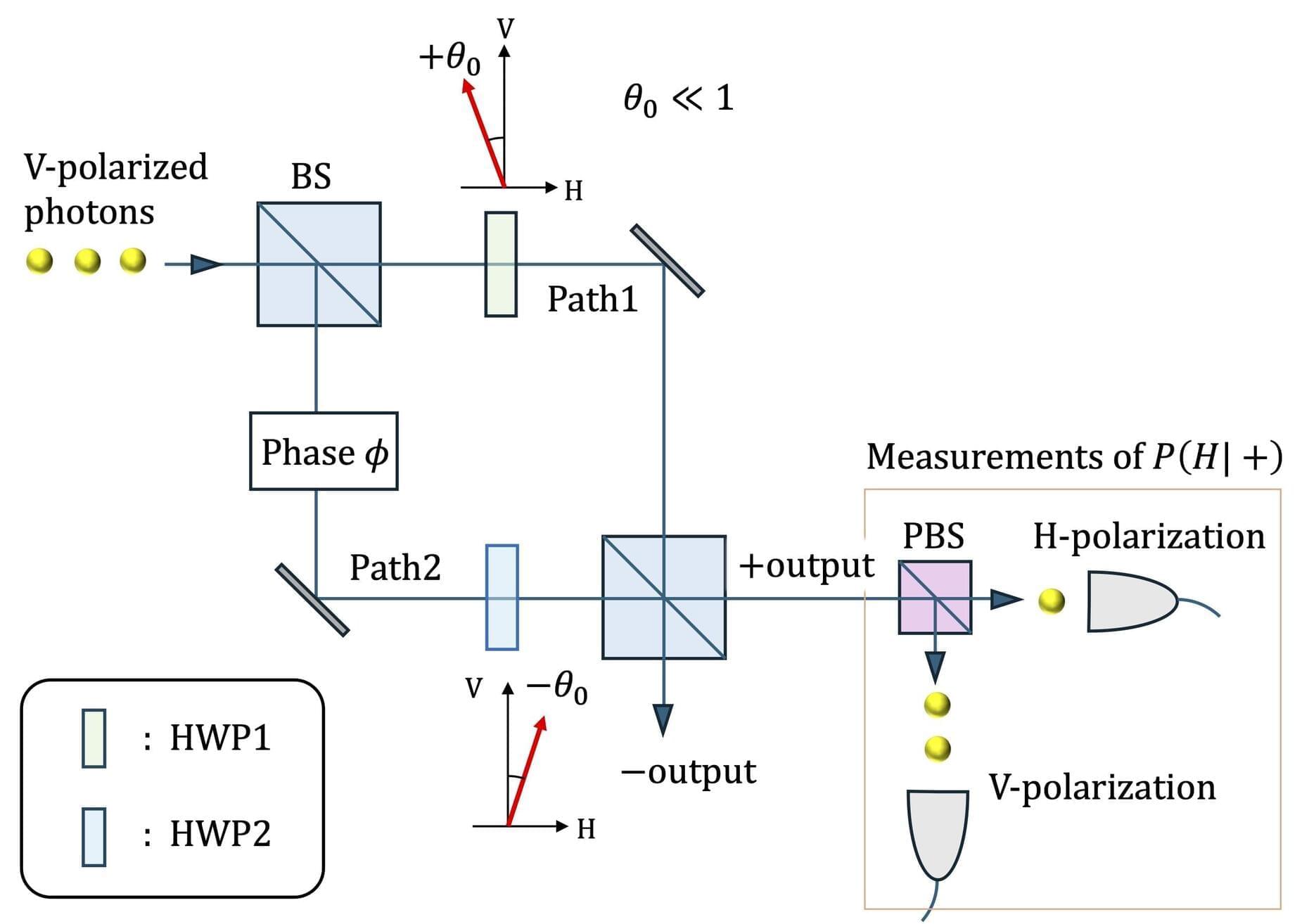
The nature of quantum particles has long puzzled scientists. While single-particle interference suggests that a photon can behave like a spread-out wave, a whole photon is only ever detected in one specific place. Traditional interpretations of quantum mechanics often address this by suggesting the particle is in a superposition of being here and there at the same time. However, this tells us only where the particle is when it is measured, not where the particle physically is when no detector is present.
A research team led by Hiroshima University, led by Holger F. Hofmann, professor at the Graduate School of Advanced Science and Engineering, has now developed a method to measure this delocalization without disturbing the photon’s wave-like path.
In a study published in the New Journal of Physics, the researchers applied a modification of the well-established method of “weak measurements” to a two-path interferometer. As the photon traveled, they applied a tiny rotation by a positive angle in one path and a negative angle in the other. If the two paths interfere in the output, the average rotation angle is always zero. However, this is only a statistical average.