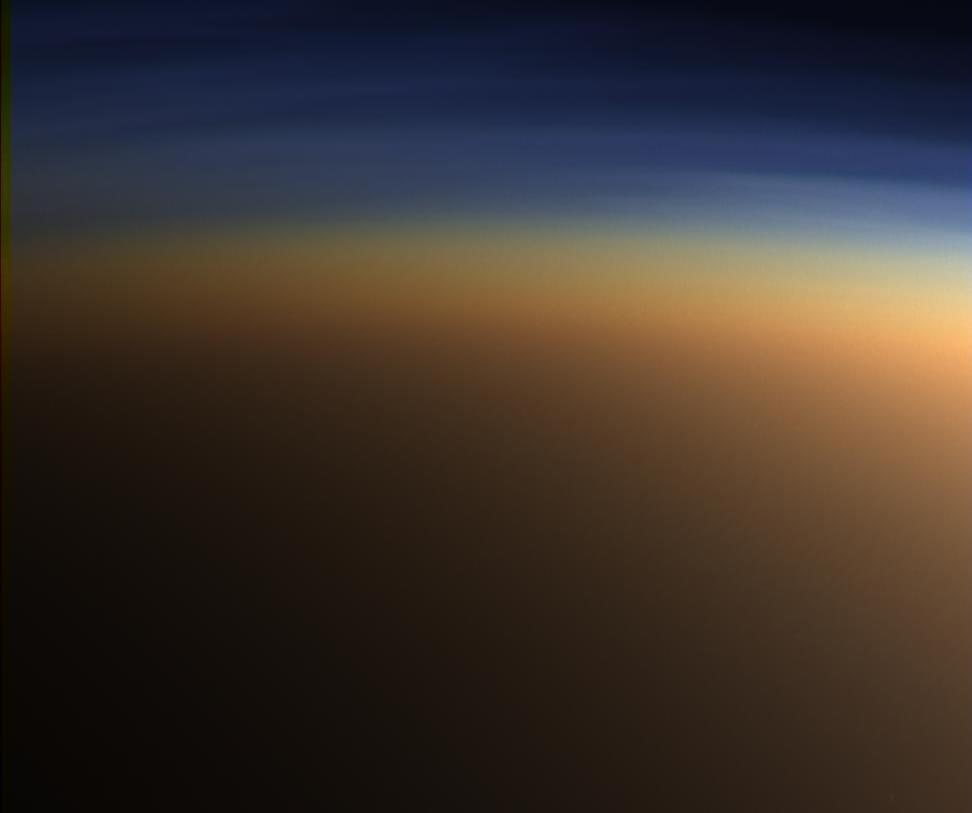
New experimental results have cast doubt on earlier proposals suggesting that spherical, cell-like membranes could form in the methane lakes of Saturn’s largest moon. Through results published in Science Advances, Tuan Vu and Robert Hodyss at NASA’s Jet Propulsion Laboratory suggest that exobiologists will likely need to explore alternative routes when considering the possibility of life on Titan.
Despite frigid surface temperatures of around −180 °C during the day, Titan is widely considered to be one of the most Earth-like bodies in the solar system. With a dense atmosphere composed mostly of nitrogen, its surface hosts lakes and seas of liquid methane and ethane, which flow, evaporate, and fall as rain in much the same way as water does on Earth.
For decades, this striking similarity to our own water cycle has inspired exobiologists to consider whether exotic forms of life could have evolved under these conditions. In 2015, researchers at Cornell University took this idea a step further through molecular-dynamics simulations designed to recreate Titan’s environment.