Over the past several decades, researchers have identified the genes and proteins in plants that initiate the cellular self-destruct sequence. During that time, they also found shared elements of this “resistome” at work in mammalian.
Plant nucleotide-binding leucine-rich repeat (NLR) immune receptors detect pathogen effectors and activate immunity. Coiled-coil NLRs (CNLs) form resistosomes as Ca2+-permeable channels in the plasma membrane (PM). However, the mechanism by which resistosomes activate cell death remains unclear.
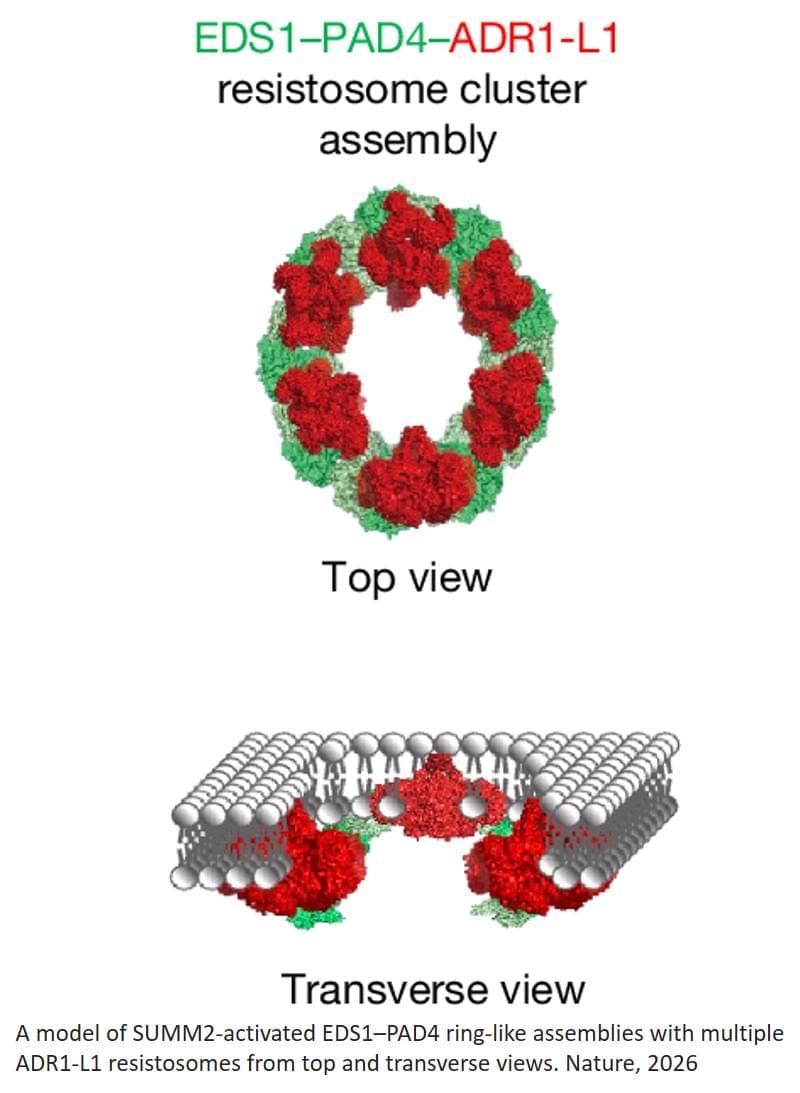
The ring, which resembles a wreath or a necklace, the author said, is a combination of proteins that bind to a cell membrane and six channels that orient themselves to run through the membrane. The team made this discovery working with Arabidopsis and Nicotiana bethamaian, popular plant model systems, and a high resolution total internal reflection fluorescence microscope.
The authors show that the CNL SUPPRESSOR OF mkk1 mkk2 2 (SUMM2), unlike canonical CNLs that use a MADA motif to penetrate the PM, tethers to the PM through N-myristoylation, a common feature among many CNLs.
PM targeting via N-myristoylation is essential for SUMM2-induced cell death. Upon activation, SUMM2 promotes the association of the lipase-like proteins ENHANCED DISEASE SUSCEPTIBILITY 1 (EDS1) and PHYTOALEXIN DEFICIENT 4 (PAD4) with the helper NLR-ACTIVATED DISEASE RESISTANCE 1-LIKE 1 (ADR1-L1).
Active SUMM2 induces the clustering of multiple ADR1-L1 resistosomes into a ring-like assembly colocalized with the EDS1–PAD4 complex, and the EDS1–PAD4–ADR1 module is essential for SUMM2-activated cell death.
The finding invites new questions about what exactly the rings do and how they do it. The team’s current hypothesis is that the rings enable communication with nearby cells, sending inflammation signals that can help initiate cell death in a targeted way. ScienceMission sciencenewshighlights.
Researchers have revealed that cells use a previously unknown feat of molecular craftsmanship to help protect their larger host organisms.
The building blocks required for this work are found across the tree of life, meaning this finding could help better understand and support plant resilience and human immune response, the researchers said.
“This is going to be interesting to a broad biological field,” said senior leader of the project. “We feel that this will raise some very exciting follow up work in medicine and agriculture.”