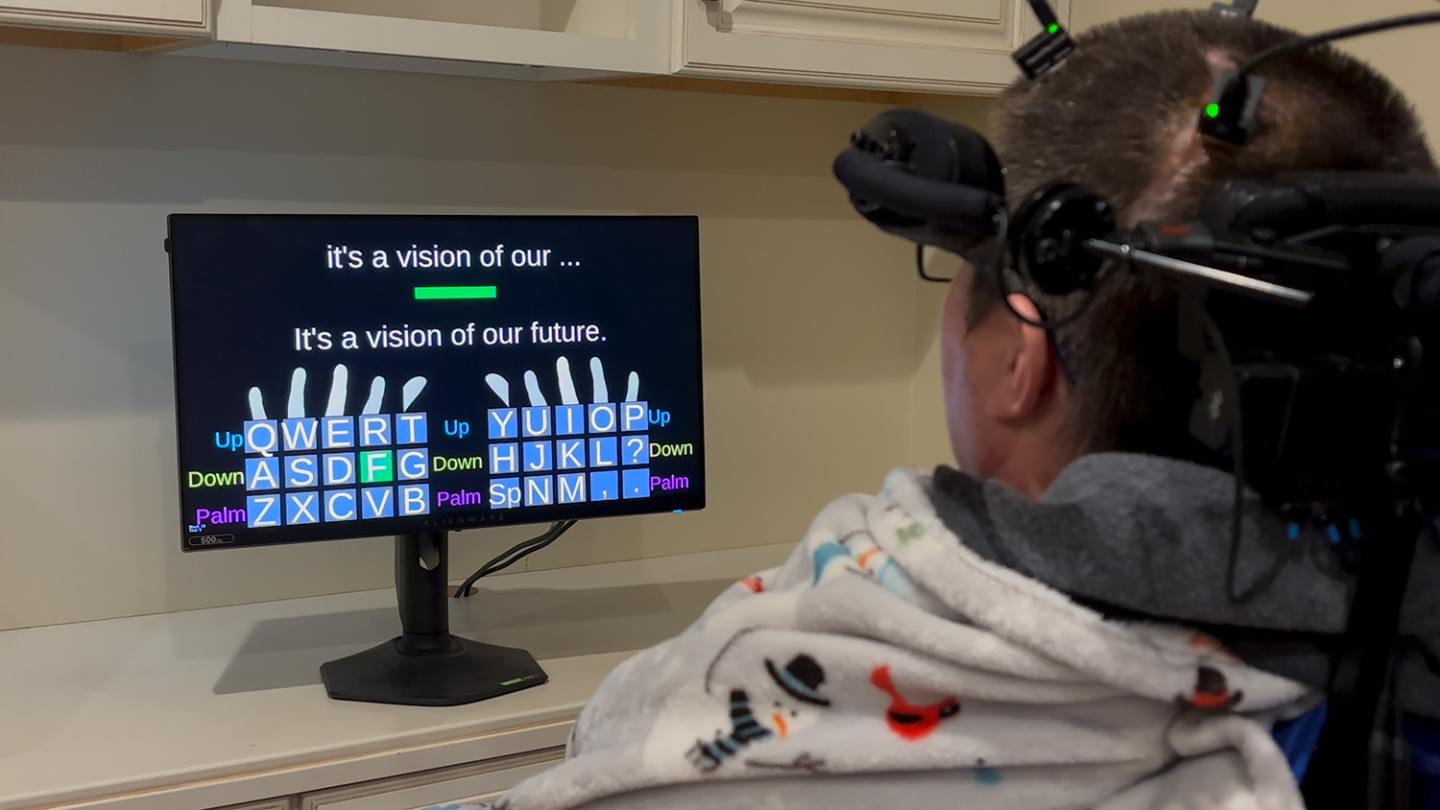
Researchers from Brown University and Mass General Brigham have developed an implantable brain-computer interface that allowed two people with paralysis — one with ALS and one with a spinal cord injury — to communicate through rapid, accurate typing. The system uses microelectrode sensors in the motor cortex, maps letters to attempted finger movements on a QWERTY keyboard, and decodes those neural signals into text.
In the study, one participant reached a top speed of 110 characters per minute (about 22 words per minute) with a 1.6% word error rate, and both participants were able to use the system from home after calibration with as few as 30 sentences. The results were published in Nature Neuroscience.
This is the kind of neurotechnology that starts to close the gap between thought and communication.
Implantable device research from the BrainGate clinical trial enables communication through rapid typing for a patient with ALS and a patient with a spinal cord injury.