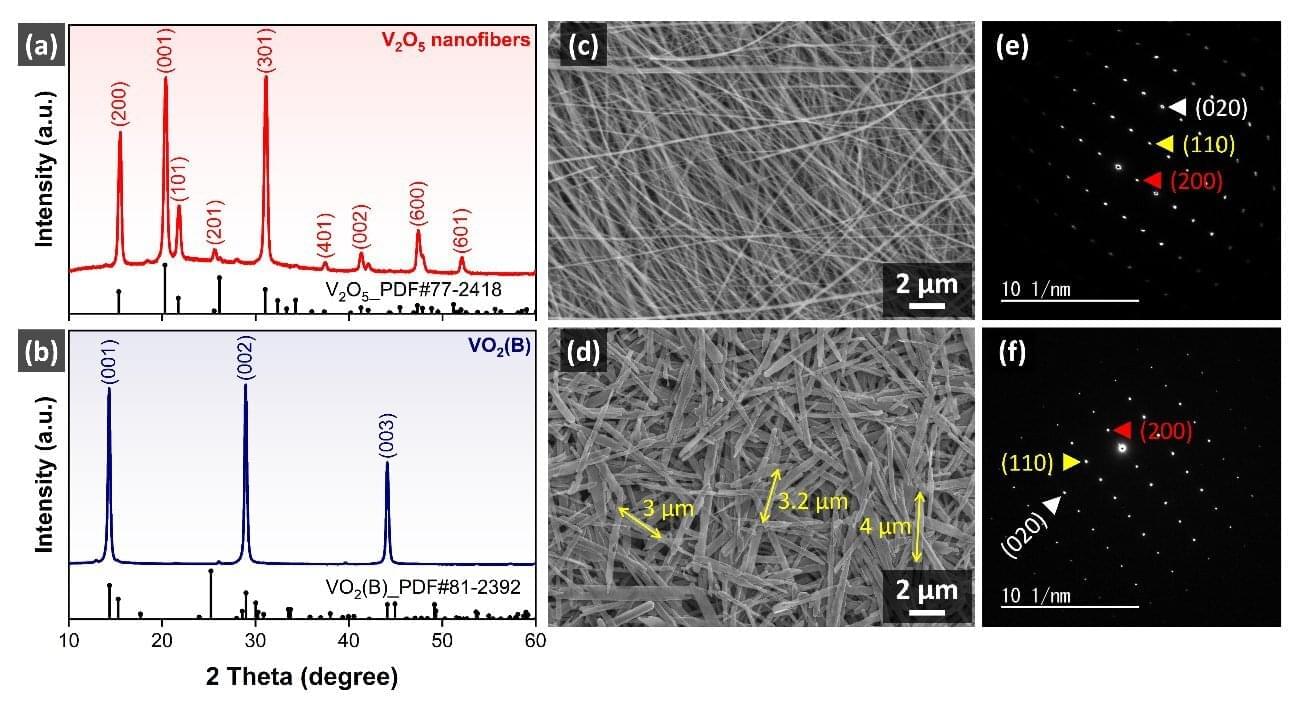
An international research team has successfully synthesized oriented belt-shaped vanadium dioxide (VO2(B)) single crystals via a hydrothermal reduction method, using one-dimensional vanadium pentoxide (V2O5) nanofibers as the starting material. This work, published in the journal ACS Sensors, provides a new material platform and design guidelines for the development of next-generation low-power gas sensors capable of operating at room temperature.
Volatile organic compounds (VOCs) emitted from industrial activities and vehicle exhaust are major urban air pollutants. Because VOCs pose serious environmental and health risks, developing effective monitoring for them is a global concern. Gas sensors can monitor for VOCs, but it has been a major challenge for scientists to develop sensors that work reliably at room temperature. Currently, metal oxide semiconductor gas sensors operate at 200°C–400°C.
“This heating requirement greatly increases power consumption and limits their use in portable devices, battery-powered systems, and large-scale Internet of Things sensor networks,” said Professor Shu Yin from the Institute of Multidisciplinary Research for Advanced Materials (IMRAM), Tohoku University (also affiliated with the Advanced Institute for Materials Research, WPI-AIMR).