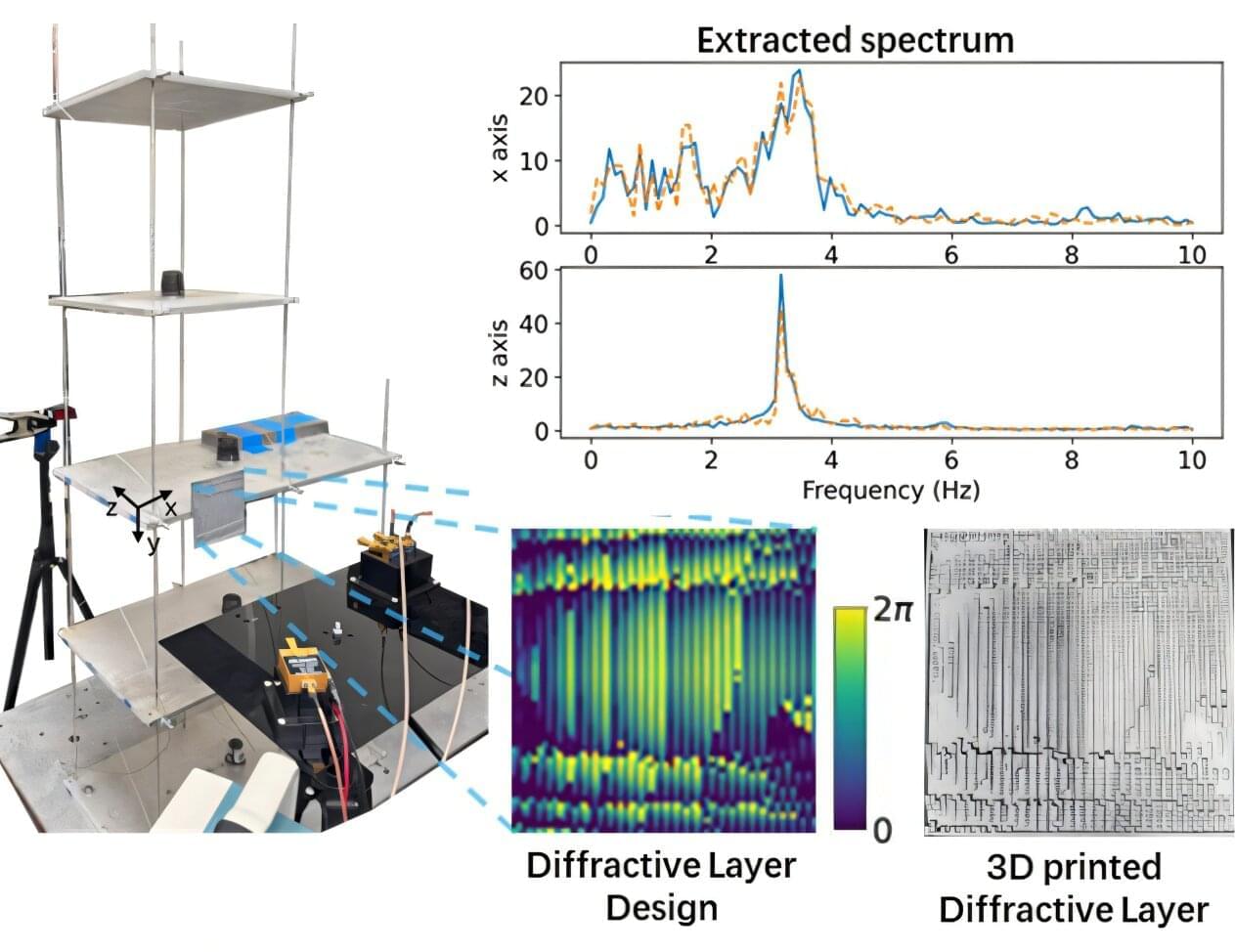
A team of researchers at the University of California, Los Angeles (UCLA) has introduced a novel framework for monitoring structural vibrations using diffractive optical processors. This new technology uses artificial intelligence to co-optimize a passive diffractive layer and a shallow neural network, allowing the system to encode time-varying mechanical vibrations into distinct spatiotemporal optical patterns.
Structural Health Monitoring (SHM) systems are vital for assessing the condition of civil infrastructure, such as buildings and bridges, particularly after exposure to natural hazards like earthquakes. Traditional vibration-based methods rely on sensor networks of accelerometers and strain gauges, which demand significant power, generate large datasets requiring complex digital signal processing, and can be expensive to install and maintain.
Furthermore, achieving high spatial resolution for accurate damage localization often requires a costly, dense sensor deployment.