Superconductors are materials that conduct electricity with an electrical resistance of zero. Superconductivity is generally observed when materials are cooled down to extremely low temperatures. In some cases, however, like in so-called high-temperature superconductors, this property emerges at higher temperatures.
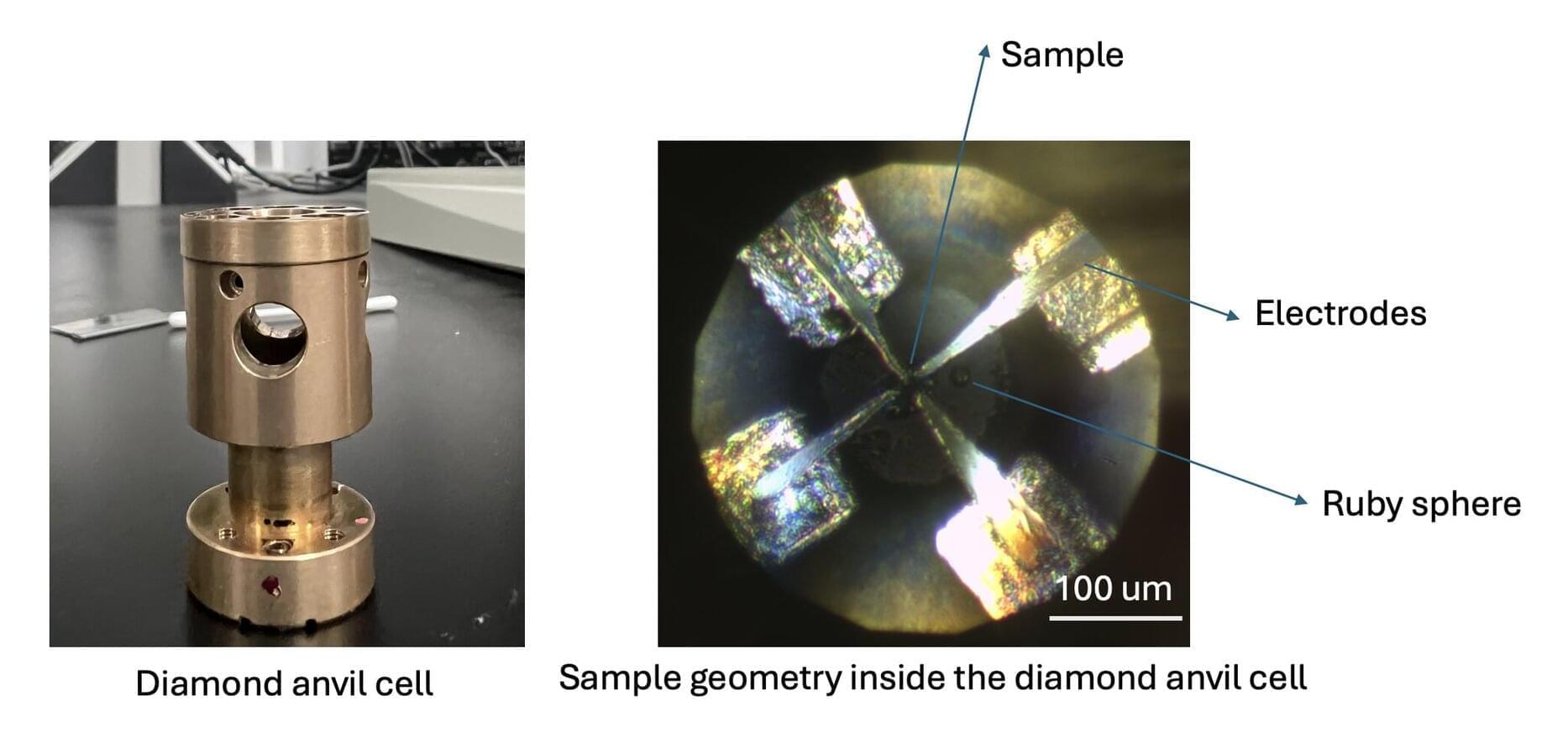
Researchers at the Center for High Pressure Science & Technology Advanced Research, Chinese Academy of Sciences and other institutes recently observed pressure-induced superconductivity in CuIr2S4, a spinel that typically becomes an insulator when cooled below about 230 K, meaning that electricity can no longer flow through it.
Their paper, published in Physical Review Letters, shows that progressively tuning this material’s crystal structure using pressure prompts the emergence of two distinct superconducting phases, dubbed SC-I and SC-II, with a maximum transition temperature of 18.2 K.