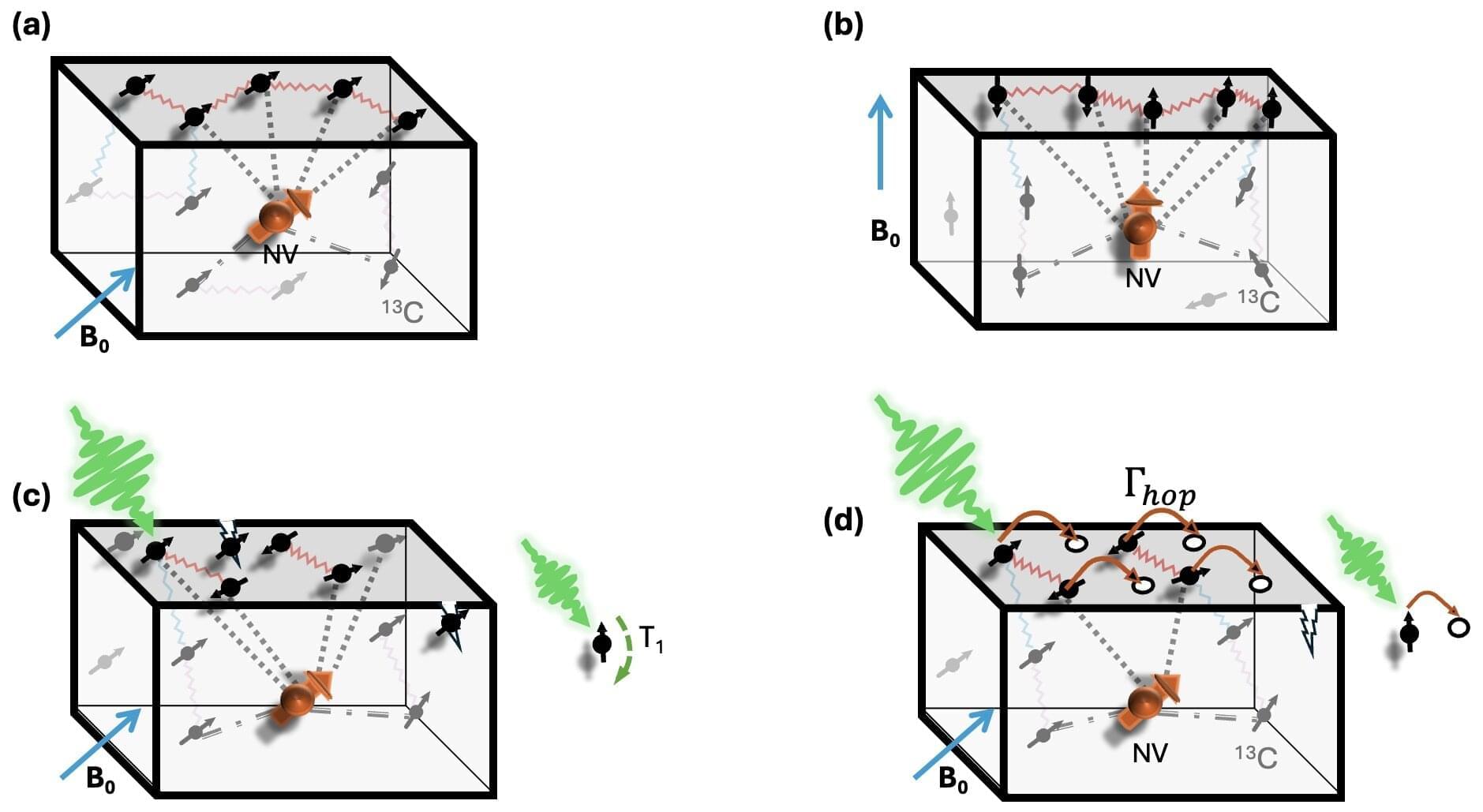
A new theoretical study led by researchers at the University of Chicago and Argonne National Laboratory has identified the microscopic mechanisms by which diamond surfaces affect the quantum coherence of nitrogen-vacancy (NV) centers—defects in diamond that underpin some of today’s most sensitive quantum sensors. The study has appeared in Physical Review Materials and was selected to be an Editors’ Suggestion paper.
“One long-standing challenge has been understanding why shallow NV centers lose coherence so quickly,” said Giulia Galli, professor at the University of Chicago Pritzker School of Molecular Engineering (UChicago PME) and senior scientist at Argonne National Laboratory. “By combining first-principles surface models with quantum dynamics simulations, we understood that the culprit of decoherence is not just which spins live on the diamond surface, but how they move: surface noise is dynamical.”
The findings of the study provide clear, physics-based guidelines for engineering diamond surfaces that help preserve quantum coherence, a key requirement for quantum sensing and emerging quantum information technologies.