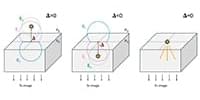
The University of Texas at Arlington researchers resolved a largely unnoticed modeling gap in how researchers interpret the behavior of single molecules at interfaces:
By treating emitters as finite-sized surface currents in contact with both media within finite-element simulations, this study provides the first physically self‑consistent framework for describing dipoles at arbitrary dielectric interfaces.
Spotlight by Matthew D. Lew.
A longstanding but largely unnoticed modeling gap has been skewing how researchers interpret the behavior of single molecules at interfaces—this work finally resolves it. Defocused fluorescence microscopy is widely used to infer molecular orientation, yet conventional models of dipole emission near refractive‑index boundaries diverge from one another depending on which side of the interface the molecule approaches. The result has been hidden, systematic biases in measured orientations. By treating emitters as finite-sized surface currents in contact with both media within finite-element simulations, this study provides the first physically self‑consistent framework for describing dipoles at arbitrary dielectric interfaces.