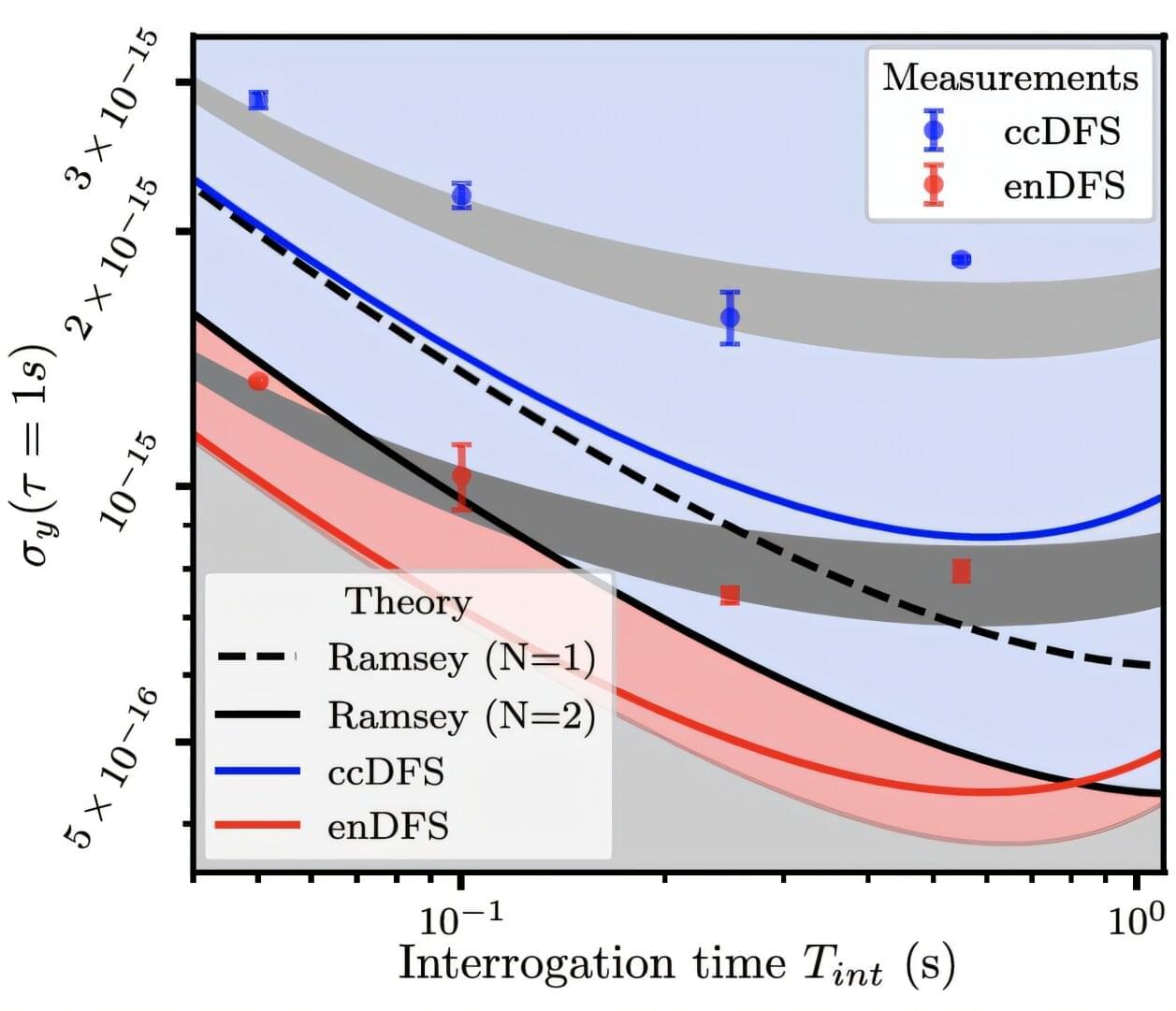
By replacing single atoms with an entangled pair of ions, physicists in Germany have demonstrated unprecedented stability in an optical clock. Publishing their results in Physical Review Letters, a team led by Kai Dietze at the German National Metrology Institute, hope their approach could help usher in a new generation of optical clocks—opening up new possibilities in precision experiments and metrology.
To measure the passing of time, every clock works by counting oscillations of some reference frequency—whether it’s the swinging pendulum of a clocktower, or the vibrations of an electrified quartz crystal in a modern digital clock. Timekeeping accuracy is directly tied to how reliable these oscillations are: while a pendulum can accrue noticeable variations in its swing, vibrating quartz is far more reliable, making quartz clocks far more accurate.
Today, optical clocks are the most precise timekeepers ever achieved. In these devices, atoms are first “probed” by an ultra-stable laser tuned close to a specific optical transition. When the laser frequency matches the energy difference between two electronic states, an electron is excited to a higher energy level.