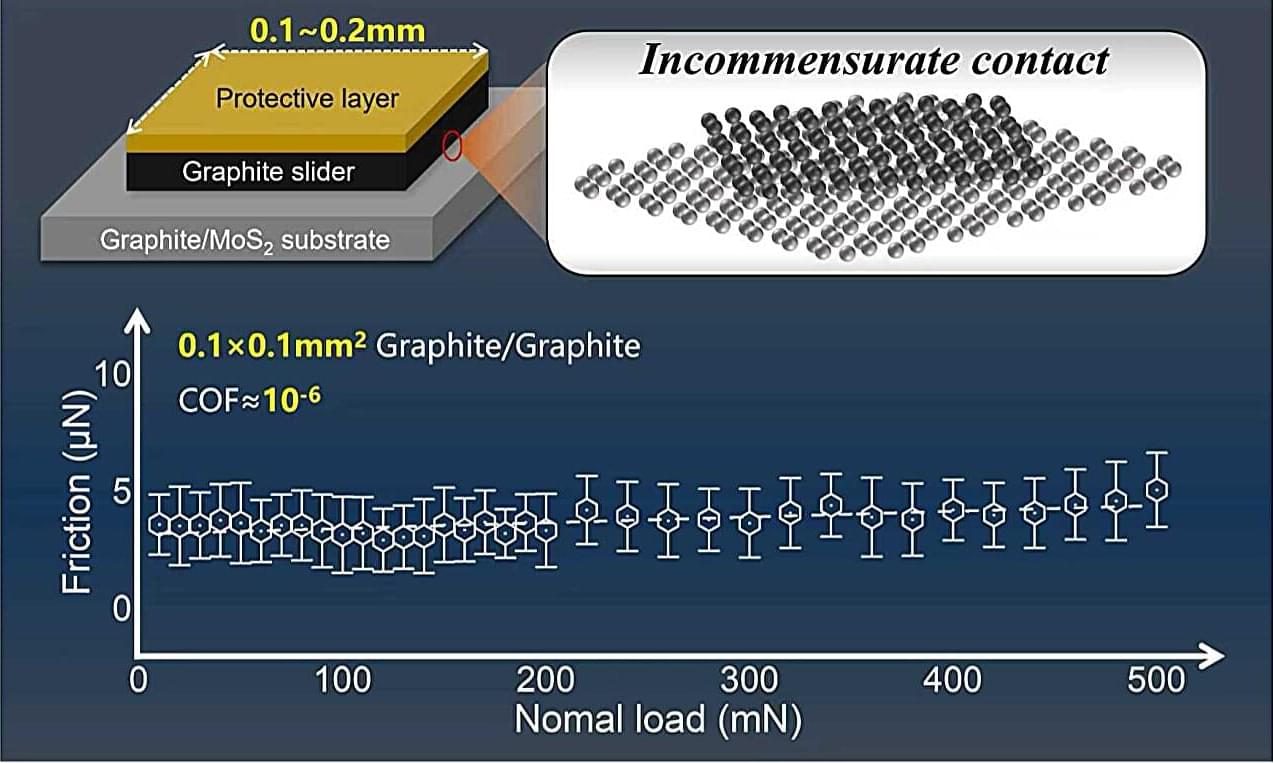
For the first time, physicists in China have virtually eliminated the friction felt between two surfaces at scales visible to the naked eye. In demonstrating “structural superlubricity,” the team, led by Quanshui Zheng at Tsinghua University, have resolved a long-standing debate surrounding the possibility of the effect. Published in Physical Review Letters, the result could potentially lead to promising new advances in engineering.
When two objects slide over each other, any roughness on their surfaces will almost inevitably resist the motion, creating the force of friction. Yet in 2004, physicists showed that friction can be virtually eliminated between two graphite surfaces, simply by rotating their respective molecular structures.
Named structural superlubricity (SSL), the effect is highly desired by engineers; in principle, allowing them to eliminate wear on both surfaces and minimize energy lost as waste heat.