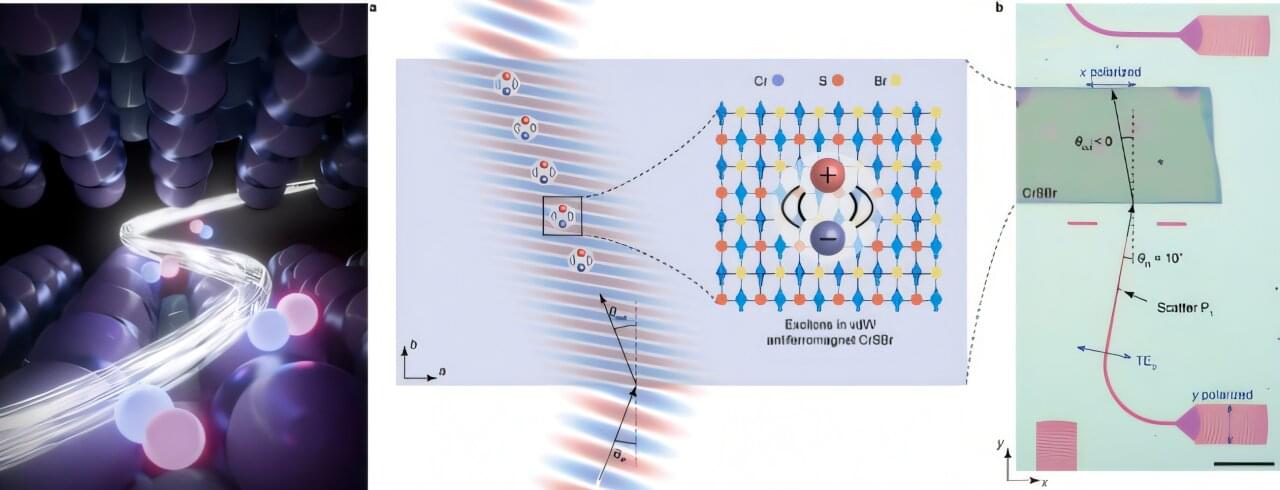
Imagine shining a flashlight into a material and watching the light bend backward—or in an entirely unexpected direction—as if defying the law of physics. This phenomenon, known as negative refraction, could transform imaging, telecommunications, and countless other technologies. Now, a team of scientists has managed to use a natural magnetic material called CrSBr to achieve negative refraction—without the need for complicated artificial structures. The study, published in Nature Nanotechnology, opens the door to ultra-compact lenses, super-high-resolution microscopes, and reconfigurable optical devices that can be controlled with magnets.
The researchers used a very thin layer of CrSBr, a material that has a unique magnetic structure—its magnetic atoms align in different ways within and between layers. This magnetic order changes how the material interacts with light. When the magnetic order is active, it causes light to bend “the wrong way,” creating negative refraction.
By guiding light into this material on a tiny chip, the team visually confirmed the backward bending of light. They also built a miniature “hyperlens” —a device that can focus light into extremely small spots—an essential step for future high-precision imaging and data processing.