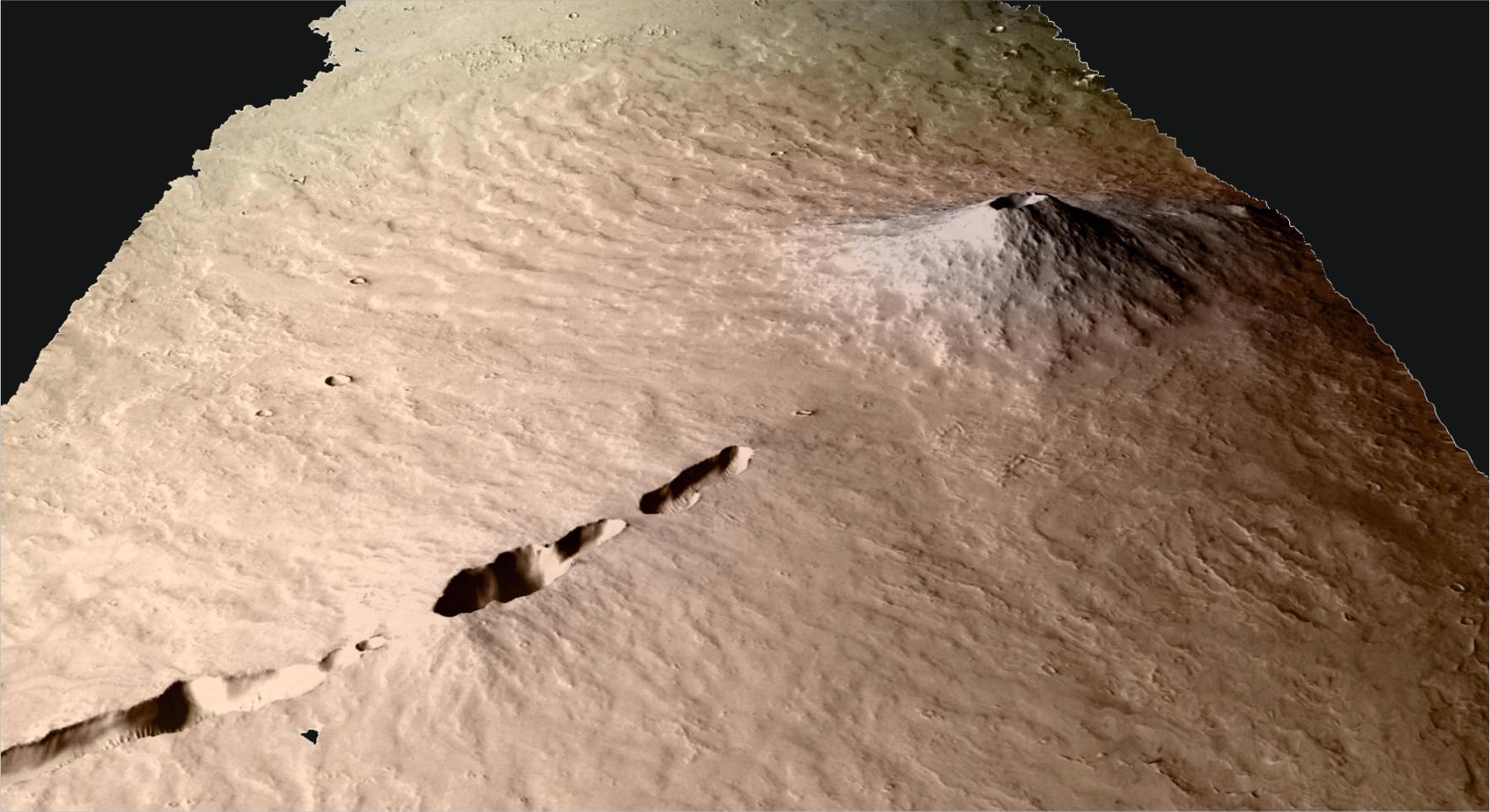
“Our results show that even during Mars’ most recent volcanic period, magma systems beneath the surface remained active and complex,” said Dr. Bartosz Pieterek. [ https://www.labroots.com/trending/space/30240/mars-volcano-f…e-phases-2](https://www.labroots.com/trending/space/30240/mars-volcano-f…e-phases-2)
How did young volcanoes on Mars form? This is what a recent study published in the journal Geology hopes to address as a team of scientists investigated the complex geological processes responsible for forming the first volcanoes on Mars. This study has the potential to help scientists better understand the recent environment on Mars over the last several million years and what this could mean for finding signs of life on the Red Planet.
For the study, the researchers used a combination of mapping and orbital data to analyze the mineralogical and geological volcanic features near one of Mars’ largest volcanoes, Pavonis Mons. The goal of the study was to ascertain the eruption history of these volcanoes, specifically whether they formed from single, short-lived eruptions or perhaps something that lasted longer and was more complex. In the end, the researchers found that the processes involved in forming the volcanoes were far more complex than previously thought. Specifically, the interior volcanic activity consisted of several magma chambers that grew and developed over time, resulting in multiple eruption events and several types of minerals that erupted onto the surface over several eruption cycles.