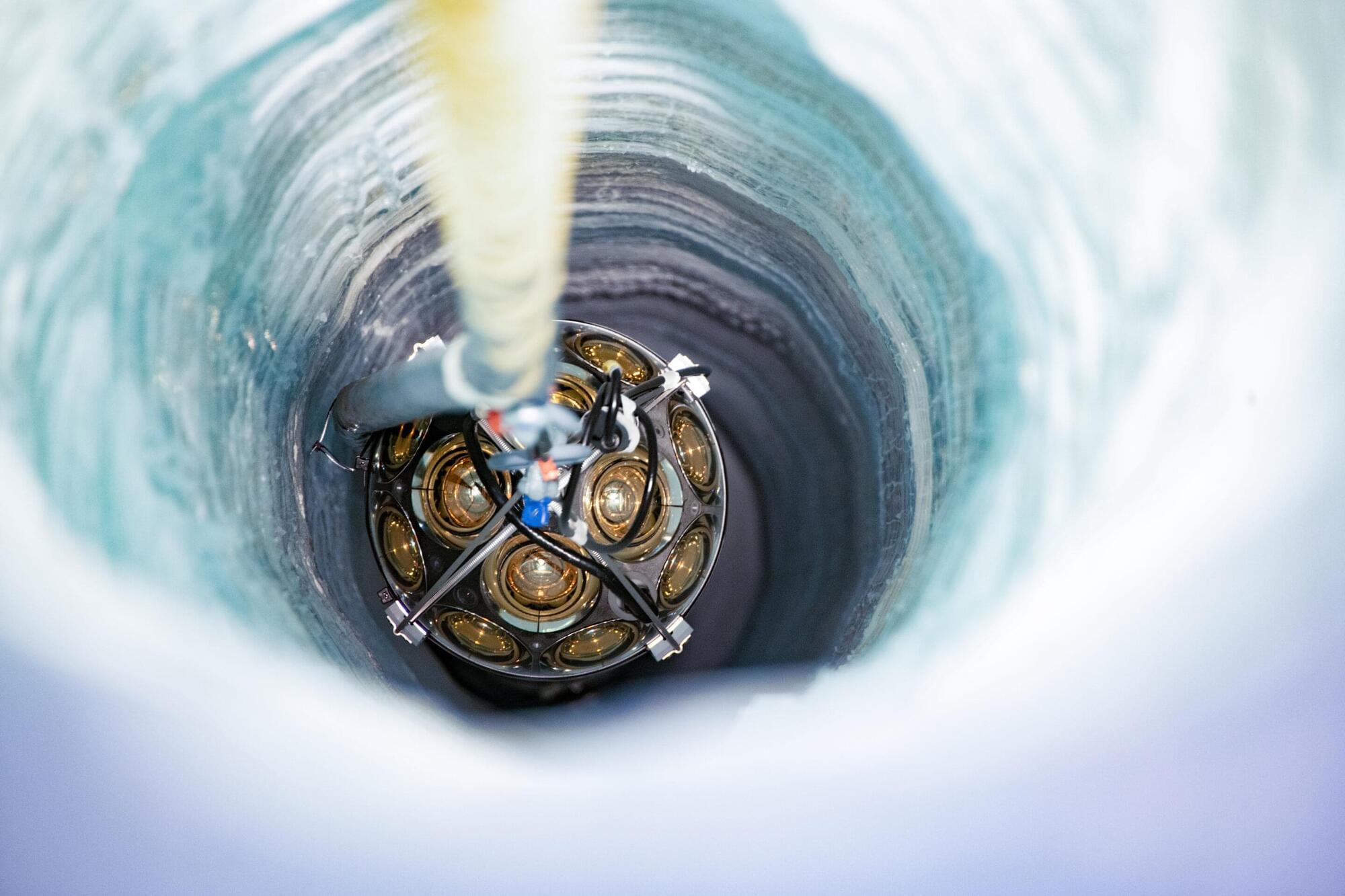
Since 2010, the IceCube Observatory at the Amundsen-Scott South Pole Station has been delivering groundbreaking measurements of high-energy cosmic neutrinos. It consists of many detectors embedded in a volume of Antarctic ice measuring approximately one cubic kilometer. IceCube has now been upgraded with new optical modules to enable it to measure lower-energy neutrinos as well. Researchers at the Karlsruhe Institute of Technology (KIT) made a significant contribution to this expansion.
IceCube serves to measure high-energy neutrinos in an ice volume of one cubic kilometer. As neutrinos themselves do not emit any signals, the tracks of muons and other secondary particles are measured precisely. Muons are elementary particles sometimes produced by the interaction of neutrinos with ice. Contrary to neutrinos, muons carry an electric charge. On their way through the ice, they produce a characteristic light cone, which is detected by highly sensitive detectors.
Now, 51 researchers from around the world have installed six new strings of novel sensors up to 2,400 meters deep into the eternal ice, thereby expanding the IceCube experiment to also measure low-energy neutrinos.