Peripheral mechanisms by which the nerve afferents send signals after nerve injury in mechanical C is not well understood.
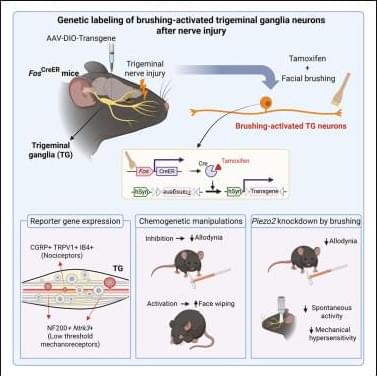
The researchers identify a subset of trigeminal afferents in mice activated by facial brushing after nerve injury. Many of brushing-activated (BA) trigeminal ganglia (TG) neurons express neurofilament200 and Ntrk3, markers for low-threshold mechanoreceptors, with lower co-localization with nociceptor markers such as Calca or Trpv1.
Inhibition of BA TG neurons reduces mechanical allodynia, while their activation increases spontaneous face wiping after nerve injury.
Knockdown of Piezo2 from BA TG afferents reduces mechanical allodynia. Thus, targeted manipulations reveal these neurons’ causal role in pain-like behaviors and heightened sensitivity, providing new insights into primary afferents underlying mechanical allodynia. sciencenewshighlights ScienceMission https://sciencemission.com/trigeminal-afferents
Peripheral mechanisms of mechanical allodynia after nerve injury remain unclear. Li et al. identify a subset of trigeminal afferents in mice activated by facial brushing after nerve injury. Targeted manipulations reveal these neurons’ causal role in pain-like behaviors and heightened sensitivity, providing new insights into primary afferents underlying mechanical allodynia.