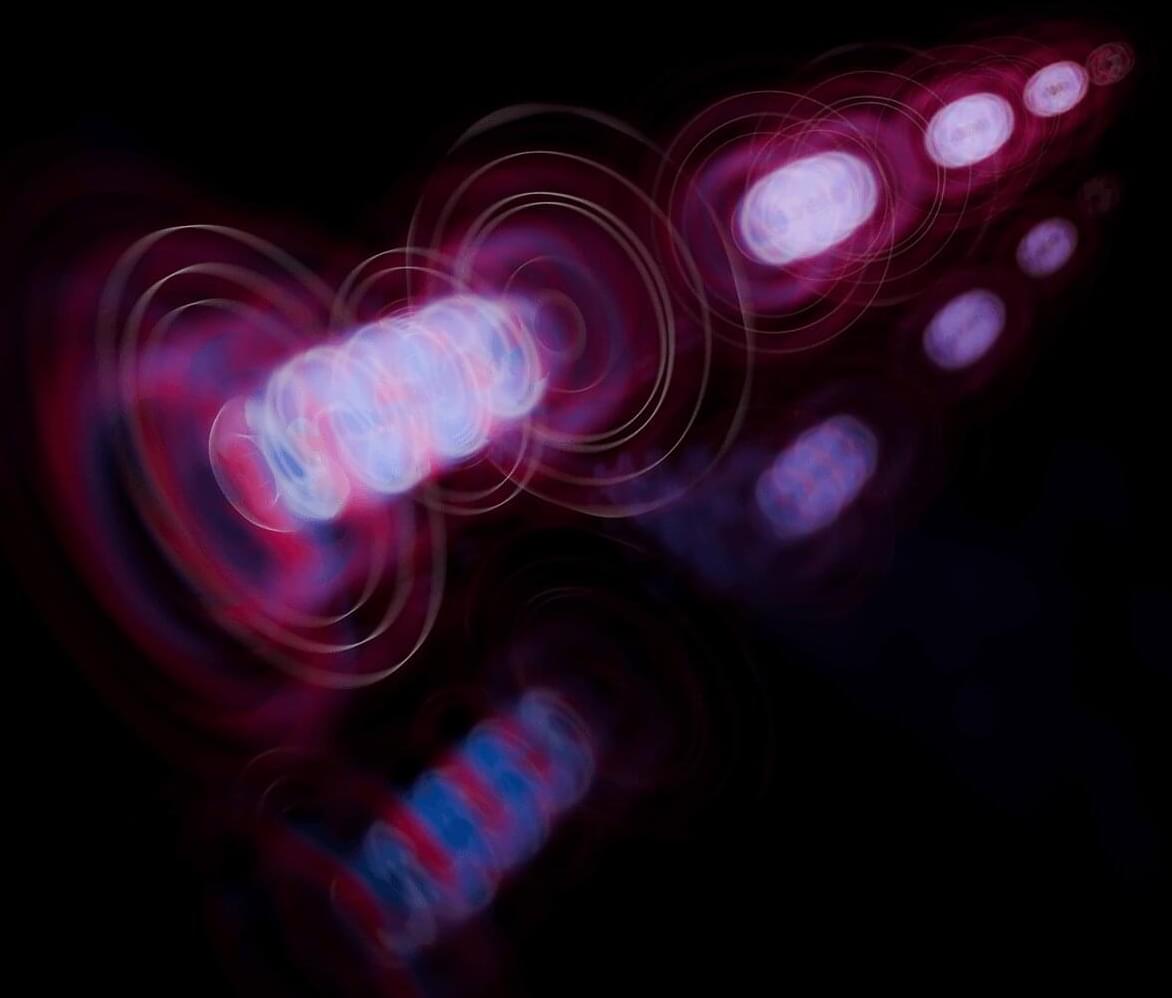
Applied physicists in the Harvard John A. Paulson School of Engineering and Applied Sciences (SEAS) have demonstrated a new way to structure light in custom, repeatable, three-dimensional patterns, all without the use of traditional optical elements like lenses and mirrors. Their breakthrough provides experimental evidence of a peculiar natural phenomenon that had been confined mostly to theory.
Researchers from the lab of Federico Capasso, the Robert L. Wallace Professor of Applied Physics and Vinton Hayes Senior Research Fellow in Electrical Engineering, report in Optica the first experimental demonstration of the little-known Montgomery effect, in which a coherent beam of light seemingly vanishes, then sharply refocuses itself over and over, in free space, at perfectly placed distances. This lensless, repeatable patterning of light could lay the groundwork for powerful new tools in many areas including microscopy, sensing, and quantum computing.
This effect had been predicted mathematically in the 1960s but never observed under controlled lab conditions. The new work underscores not only that the effect is real, but that it can be precisely engineered and tuned.