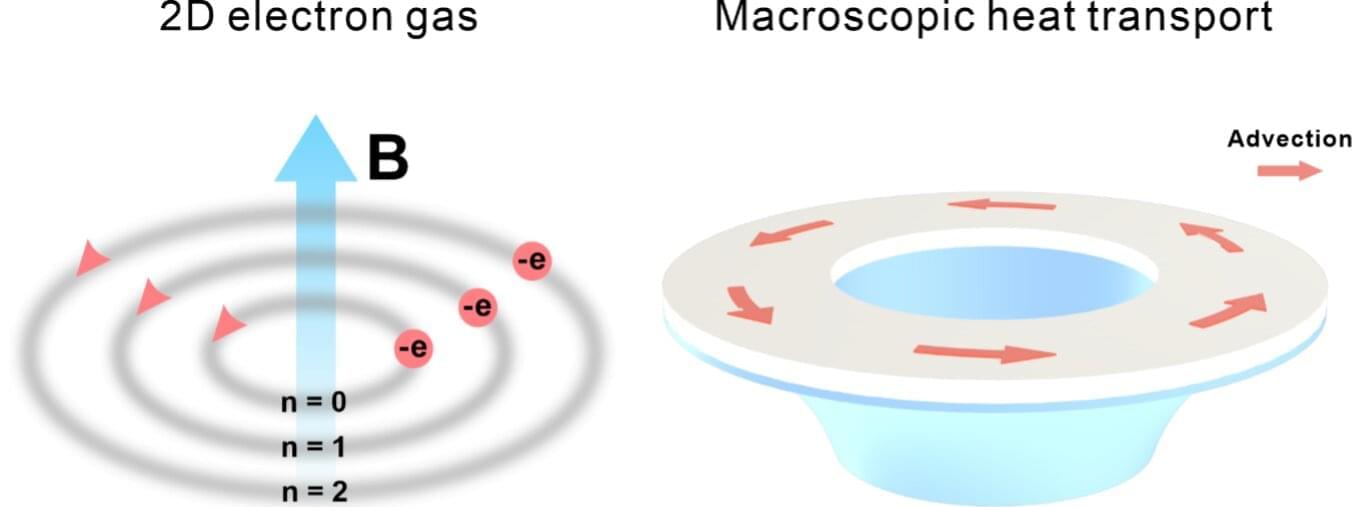
In many quantum materials—materials with unusual electrical and magnetic properties driven by quantum mechanical effects—electrons can organize themselves into Landau levels are essentially quantized energy states that form when charged particles move in a magnetic field.
This process, called Landau quantization, forces electrons into circular (i.e., cyclotron) motion. This motion ultimately produces evenly spaced Landau levels, which are known to underpin various physical phenomena, including the quantum Hall effect.
The quantum Hall effect is a quantum equivalent of the Hall effect that emerges in some two-dimensional (2D) materials at extremely low temperatures and under strong magnetic fields. This effect prompts electrical current to flow along the edges of a material with extremely low loss of energy.