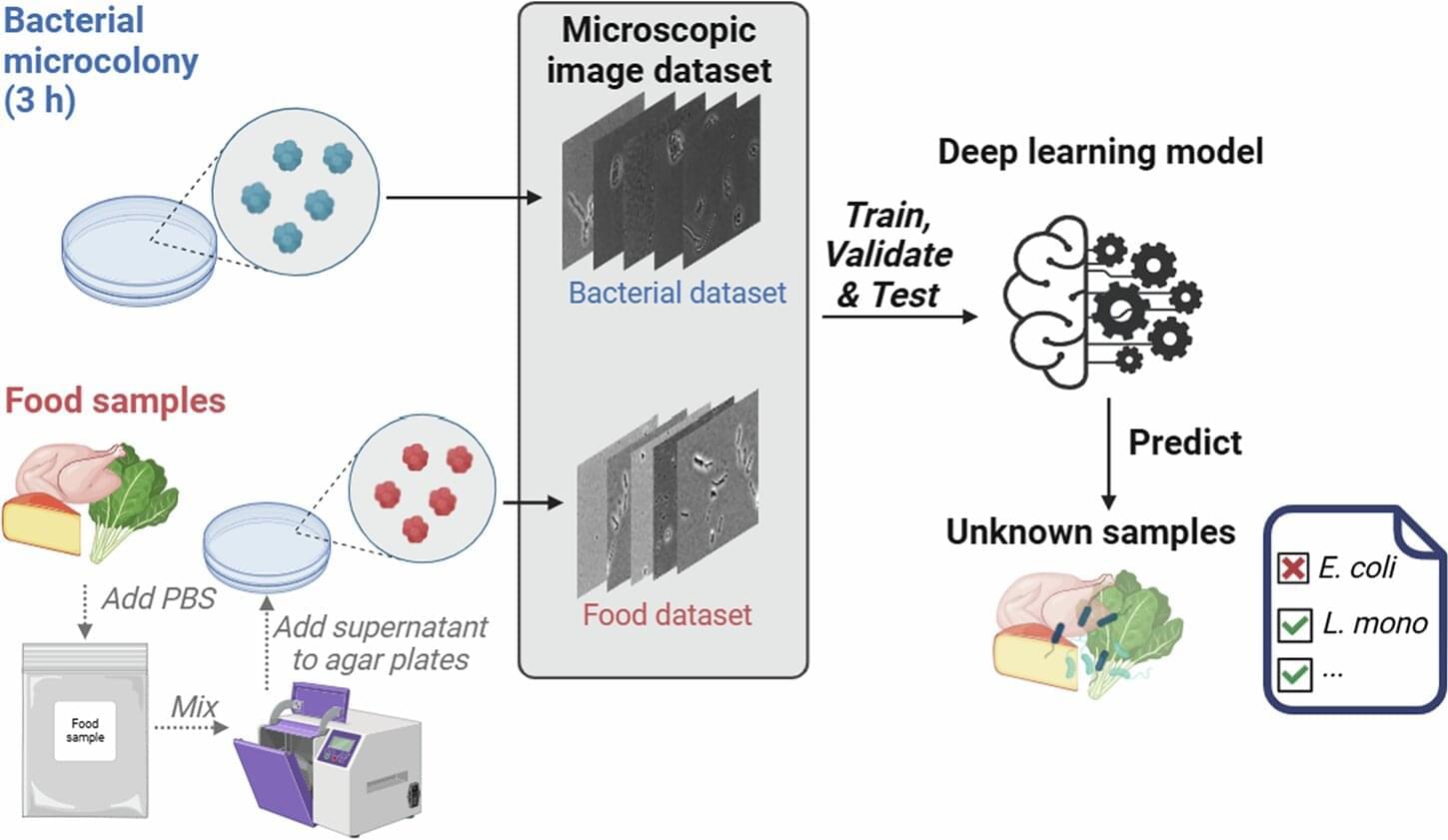
Researchers have significantly enhanced an artificial intelligence tool used to rapidly detect bacterial contamination in food by eliminating misclassifications of food debris that looks like bacteria. Current methods to detect contamination of foods such as leafy greens, meat and cheese, which typically involve cultivating bacteria, often require specialized expertise and are time-consuming—taking several days to a week.
Luyao Ma, an assistant professor at Oregon State University, and her collaborators from the University of California, Davis, Korea University and Florida State University, have developed a deep learning-based model for rapid detection and classification of live bacteria using digital images of bacteria microcolonies. The method enables reliable detection within three hours. The findings are published in the journal npj Science of Food.
Their latest breakthrough involves training the model to distinguish bacteria from microscopic food debris to improve its accuracy. A model trained only on bacteria misclassified debris as bacteria more than 24% of the time. The enhanced model, trained on both bacteria and debris, eliminated misclassifications.