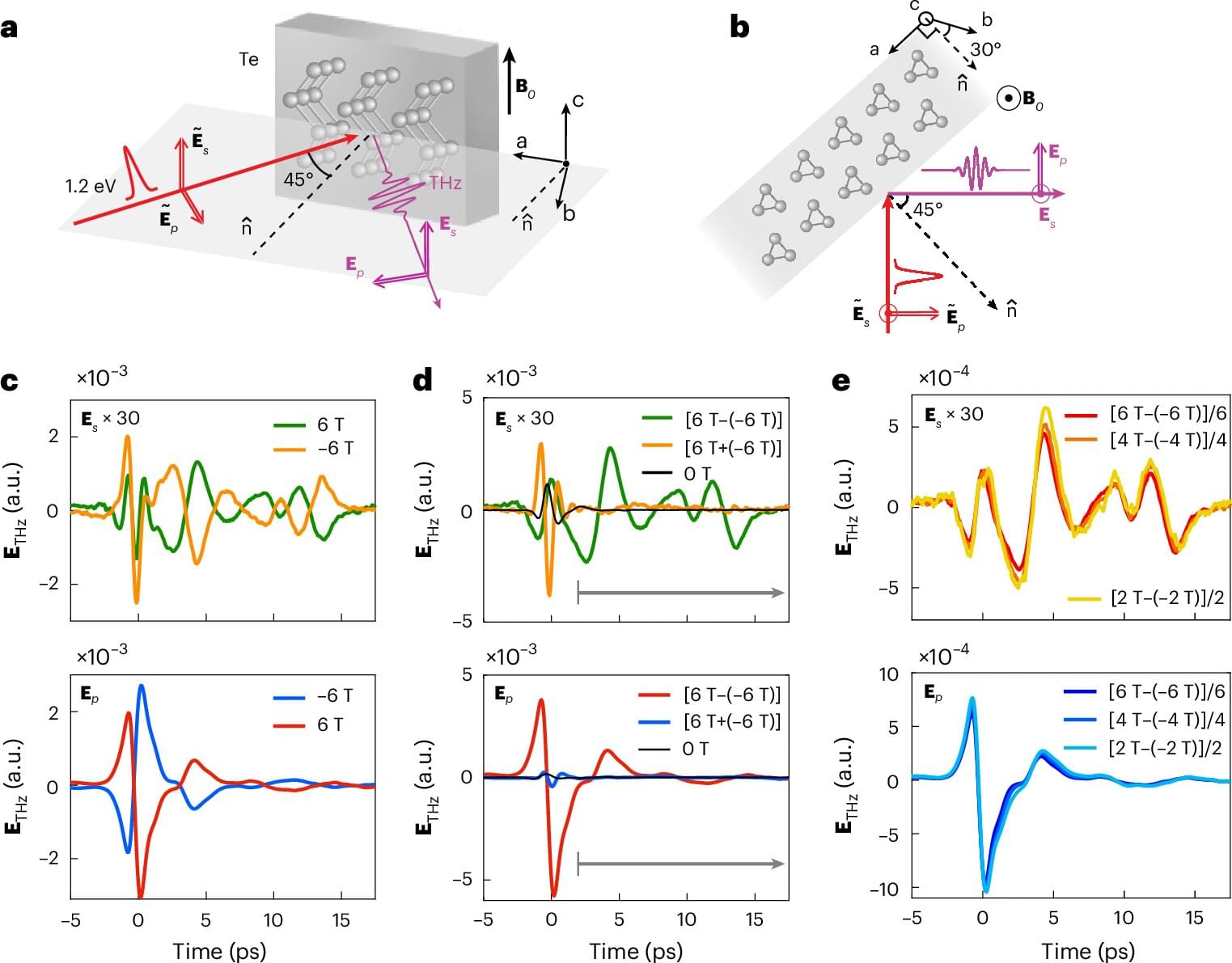
Researchers from The Grainger College of Engineering at the University of Illinois Urbana-Champaign have reported the first observation of a dynamic magnetochiral instability in a solid-state material. Their findings, published in Nature Physics, bridge ideas from nuclear and high-energy physics with materials science and condensed matter physics to explain how the interplay between symmetry and magnetism can amplify electromagnetic waves.
A material’s behavior is heavily influenced by its symmetries. One unique symmetry of interest to many physicists is chirality. Chiral materials have non-superimposable mirror images, like a right and left hand. For physicists like Fahad Mahmood, Rafael Fernandes and Jorge Noronha, the nonlinear interaction between chiral materials and light is of particular interest. How do these materials respond when light triggers effects beyond the straightforward, linear response?
“If I have a shiny crystal and I put a red laser on it, I’ll get red light back; that’s a linear response, as the frequencies—or colors—of the incoming and outgoing light are the same,” Mahmood said. “You can go a little further and try to excite some frequency so that it sends back a different color: you put red light on something, and it shines back as green, blue or yellow. That’s nonlinear response.”