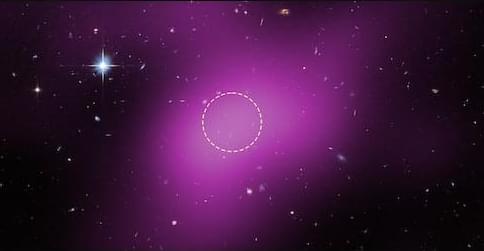
Galaxies announce themselves through the light of billions of stars, all embedded in vast clumps, or “halos,” of dark matter. But researchers may have spotted, for the first time, a starless halo of dark matter—containing only a gas cloud. The result was announced by Rachael Beaton of the Space Telescope Science Institute in Maryland at the meeting of the American Astronomical Society in Phoenix, Arizona. Using observations from the Hubble Space Telescope, Beaton and her collaborators showed that the object, known as Cloud-9, contains a negligible amount of stars [1]. “There is nothing like this that we have found so far in the Universe,” Beaton said in a press conference last week.
Cloud-9’s makeup—as inferred from radio and optical observations—would qualify it as the first example of a REionization-Limited H I Cloud (RELHIC), a starless dark matter halo filled with neutral hydrogen gas (H I). RELHICs are thought to be leftovers of dark matter clumps that couldn’t accrue a sufficient amount of gas to form stars, says the project’s principal investigator Alejandro Benítez-Llambay of the University of Milano-Bicocca in Italy. A RELHIC is “a tale of a failed galaxy,” he says.
Starless halos arise naturally within the standard paradigm of cosmology: the lambda cold dark matter (ΛCDM) model, where Λ refers to a “cosmological constant” that describes dark energy. According to ΛCDM, dark matter can cluster into halos that provide the gravitational backbone for galaxy formation. The model also predicts that there is a critical mass below which halos would be too small to ever form stars. Spotting unlit halos might sound hopeless, but simulations by Benítez-Llambay and collaborators in 2017 suggested that halos within a narrow mass range may exist as RELHICs (a term they coined) [2]. According to their calculations, RELHICs would have masses close to the critical value for galaxy formation. Crucially, the compact, hydrogen-filled cores of these objects provide a potential observational window, since hydrogen clouds have a characteristic radio emission.