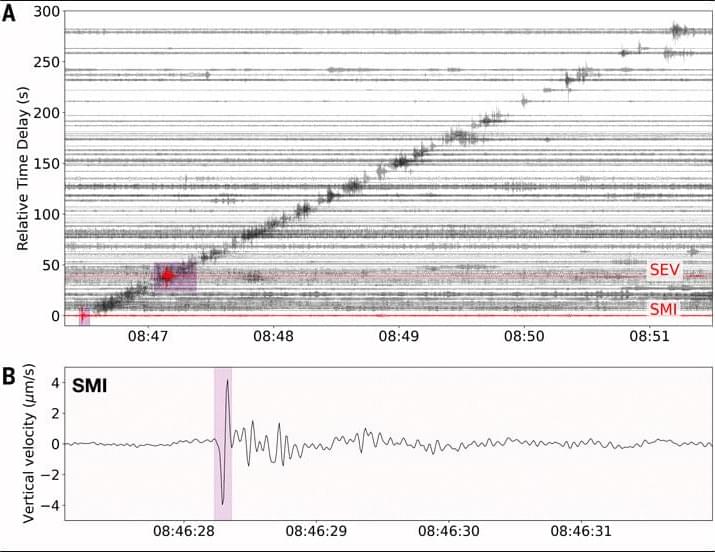
Therefore, there is a pressing need to develop tools that can be used to determine the trajectory, size, nature, and potential impact locations of reentering debris in near real time. This is a critical step toward mobilizing appropriate response operations (7). In this work, we have demonstrated that open-source seismic data are capable of fulfilling this requirement.
Past work has demonstrated the sensitivity of seismometers to reentry-generated shockwaves and explosions of natural meteoroids [for example, (8–10)]. However, the trajectories, speeds, and fragmentation chains of artificial spacecraft falling from orbit are distinct from those of natural objects entering from beyond the Earth‒Moon system. This means that the patterns of debris fallout that artificial spacecraft produce are also potentially more complex; for example, some components such as fuel tanks are structurally reinforced and hence more likely to survive and impact the ground, whereas others (such as solar panels) are deliberately designed to demise during reentry. Therefore, techniques used for natural objects require modification.