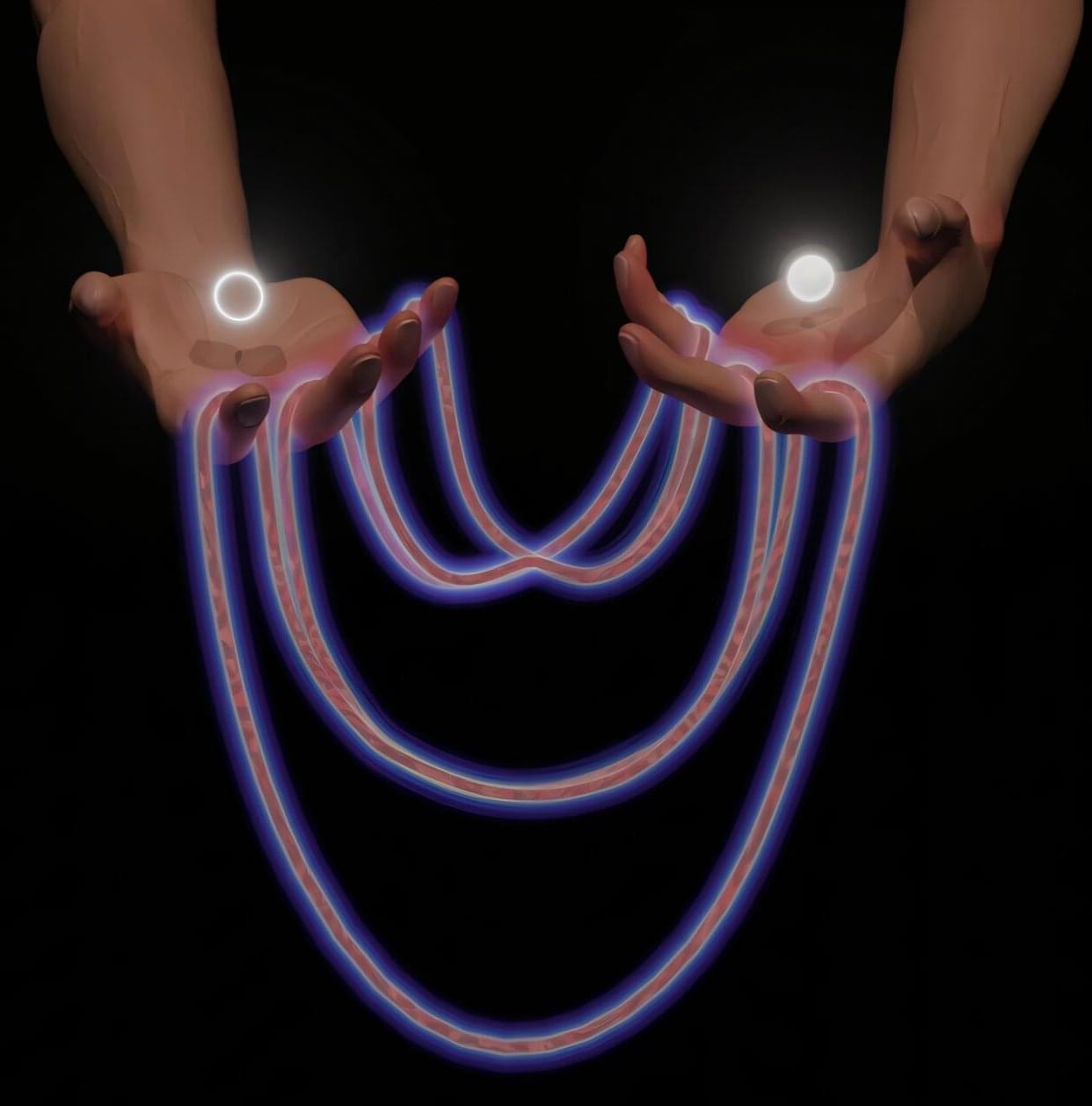
What if you could create new materials just by shining a light at them? To most, this sounds like science fiction or alchemy, but to physicists investigating the burgeoning field of Floquet engineering, this is the goal. With a periodic drive, like light, scientists can “dress up” the electronic structure of any material, altering its fundamental properties—such as turning a simple semiconductor into a superconductor.
While the theory of Floquet physics has been investigated since a bold proposal by Oka and Aoki in 2009, only a handful of experiments within the past decade have managed to demonstrate Floquet effects. And though these experiments show the feasibility of Floquet engineering, the field has been limited by the reliance on light, which requires very high intensities that almost vaporize the material while still only achieving moderate results.
But now, a diverse team of researchers from around the world, co-led by the Okinawa Institute of Science and Technology (OIST) and Stanford University have demonstrated a powerful new alternative approach to Floquet engineering by showing that excitons can produce Floquet effects much more efficiently than light. Their results are now published in Nature Physics.