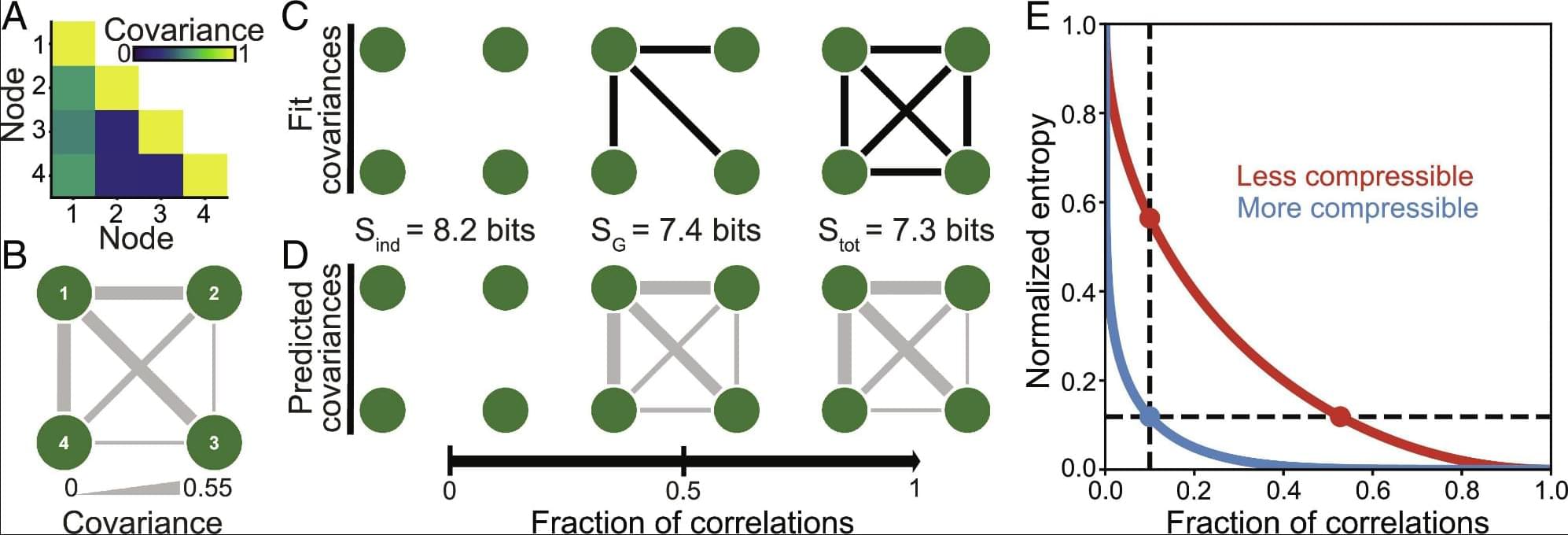
One of the most-viewed PNAS articles in the last week is “Quantifying the compressibility of the human brain.” Explore the article here: https://ow.ly/jGEu50Y6heQ
For more trending articles, visit https://ow.ly/FjuI50Y6heP.
In the human brain, the allowed patterns of activity are constrained by the correlations between brain regions. Yet it remains unclear which correlations—and how many—are needed to predict large-scale neural activity. Here, we present an information-theoretic framework to identify the most important correlations, which provide the most accurate predictions of neural states. Applying our framework to cortical activity in humans, we find that the vast majority of variance in activity is explained by a small number of correlations. This means that the brain is highly compressible: Only a sparse network of correlations is needed to predict large-scale activity. We find that this compressibility is strikingly consistent across different individuals and cognitive tasks and that, counterintuitively, the most important correlations are not necessarily the strongest.