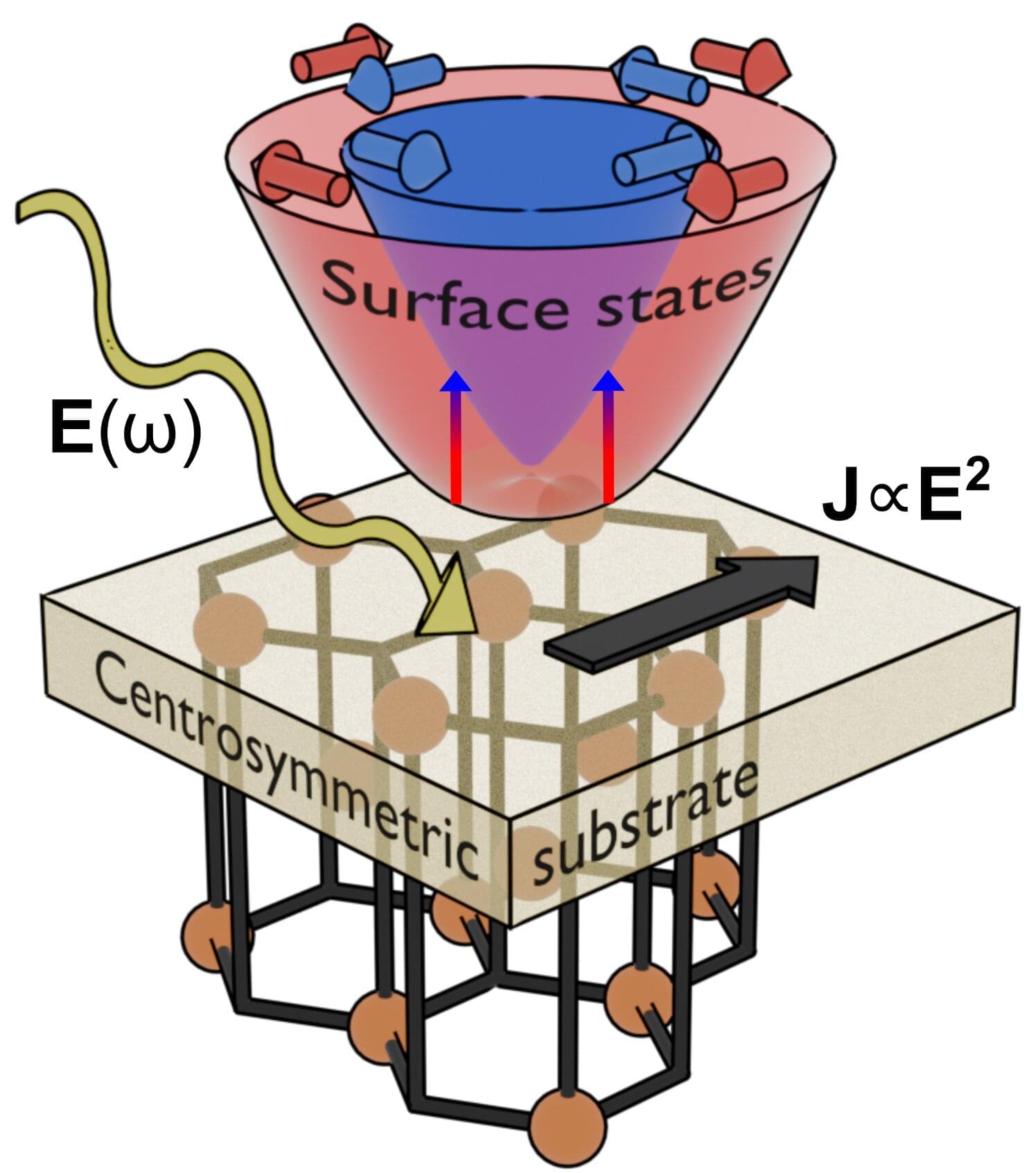
A recent study carried out by researchers from EHU, the Materials Physics Center, nanoGUNE, and DIPC introduces a novel approach to solar energy conversion and spintronics. The work tackles a long-standing limitation in the bulk photovoltaic effect—the need for non-centrosymmetric crystals—by demonstrating that even perfectly symmetric materials can generate significant photocurrents through engineered surface electronic states. This discovery opens new pathways for designing efficient light-to-electricity conversion systems and ultrafast spintronic devices.
The work is published in the journal Physical Review Letters.
Conventional solar cells rely on carefully engineered interfaces, such as p–n junctions, to turn light into electricity. A more exotic mechanism—the bulk photovoltaic effect —can generate electrical current directly in a material without such junctions, but only if its crystal structure lacks inversion symmetry. This strict requirement has long restricted the search for practical materials.