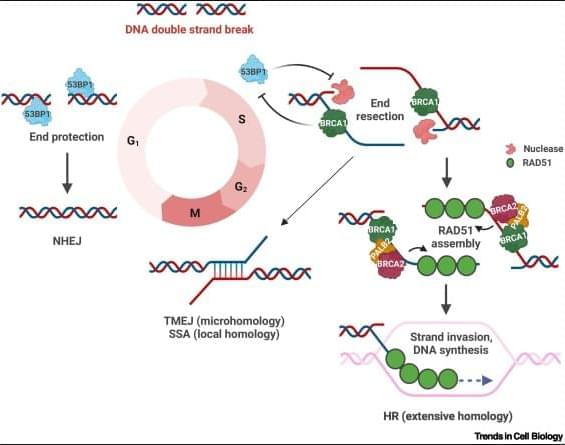
BRCA1-mediated DNA recombination repair and tumor suppression.
BRCA1 is dispensable for end resection at replication-coupled double-strand breaks (DSBs) but stimulates processing of replication-independent DSBs.
BRCA1 promotes RAD51 assembly downstream of end resection.
Canonical BRCA1/RAD51-dependent homologous recombination is essential for tumor suppression.
Loss of 53BP1 enables alternative BRCA1-independent RAD51 assembly.
Alternative BRCA1-independent RAD51 assembly supports tissue development but is not sufficient for tumor suppression. sciencenewshighlights ScienceMission https://sciencemission.com/BRCA1-mediated-DNA-recombination-repair
Ever since BRCA1 germline mutations were found to confer a strong predisposition to the development of breast and ovarian cancers, there has been great interest in determining how this protein suppresses tumor formation. Through more than two decades of research, it has become clear that BRCA1 safeguards our genome mainly by promoting DNA repair through homologous recombination (HR). This opinion article outlines our evolving view of BRCA1’s role in end resection, an upstream commitment step for HR, and highlights recent discoveries suggesting that the context in which DNA breaks are generated dictates whether BRCA1 is required for end resection. In addition, strong emerging evidence for the tumor-suppressive function of BRCA1 being mediated predominantly by its indispensable role in supporting RAD51-dependent recombination downstream of end resection is discussed.