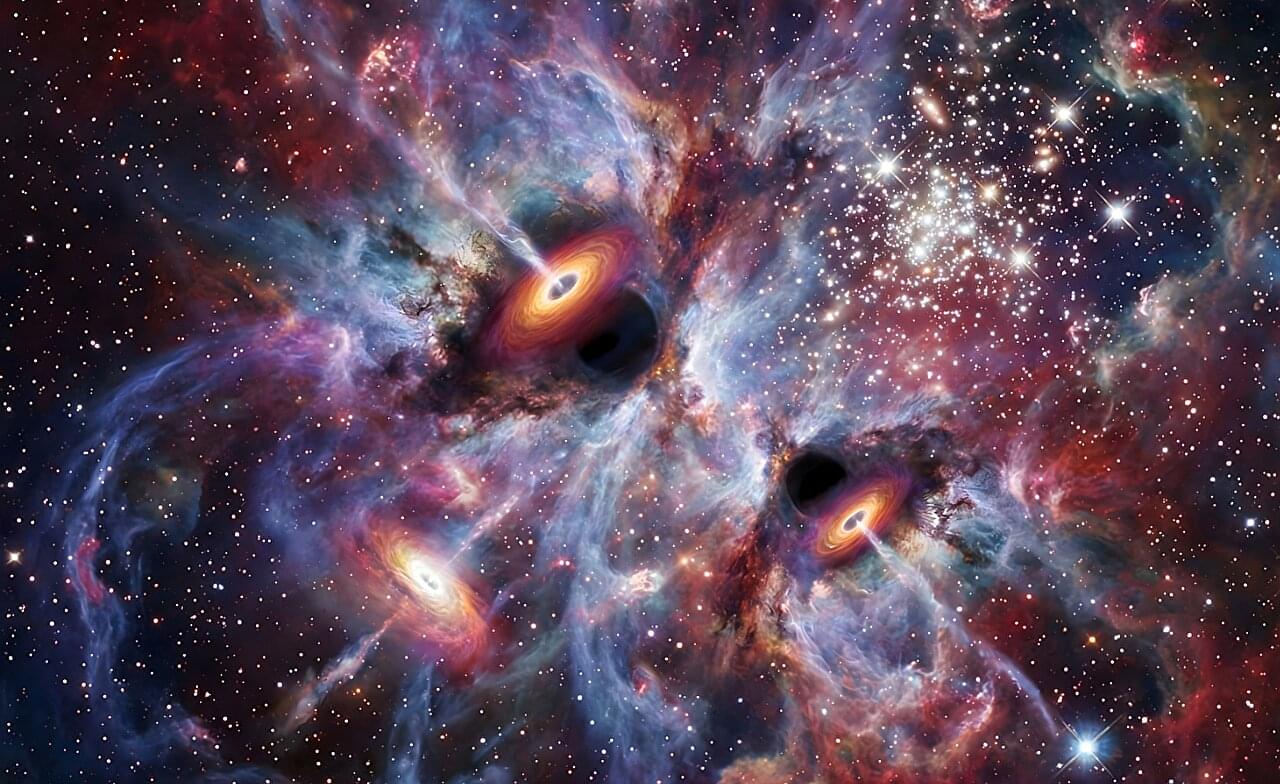
It’s one of astronomy’s great mysteries: how did black holes get so big, so massive, so quickly. An answer to this cosmic conundrum has now been provided by researchers at Ireland’s Maynooth University (MU) and reported today in Nature Astronomy.
“We found that the chaotic conditions that existed in the early universe triggered early, smaller black holes to grow into the super-massive black holes we see later following a feeding frenzy which devoured material all around them,” says Daxal Mehta, a Ph.D. candidate in Maynooth University’s Department of Physics, who led the research.
“We revealed, using state-of-the-art computer simulations, that the first generation of black holes—those born just a few hundred million years after the Big Bang—grew incredibly fast, into tens of thousands of times the size of our sun.”