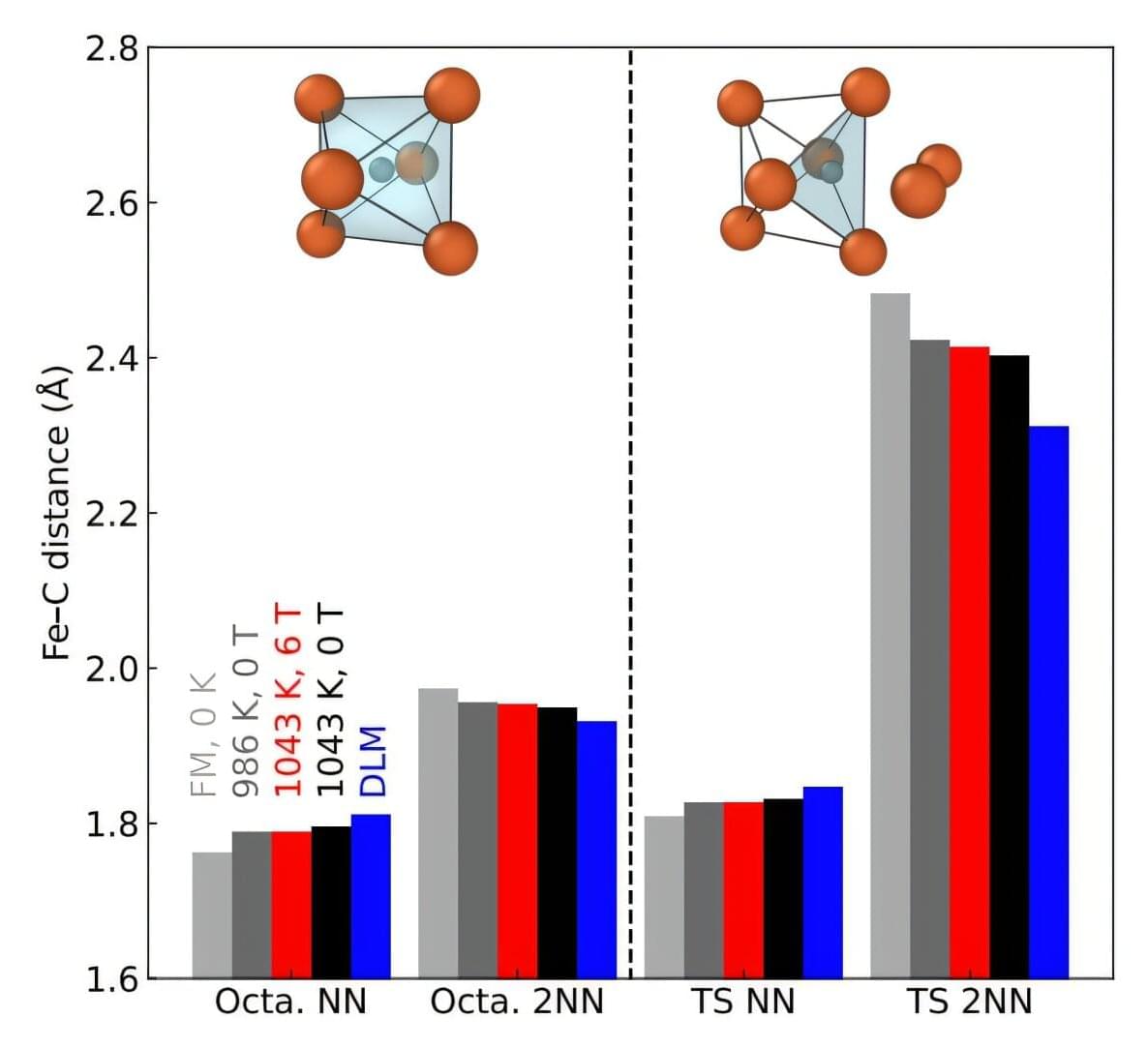
Professor Dallas Trinkle and colleagues have provided the first quantitative explanation for how magnetic fields slow carbon atom movement through iron, a phenomenon first observed in the 1970s but never fully understood. Published in Physical Review Letters, their computer simulations reveal that magnetic field alignment changes the energy barriers between atomic “cages,” offering potential pathways to reduce the energy costs and CO2 emissions associated with steel processing.
An alloy of iron and carbon, steel is one of the most-used building materials on the planet. Engineering its microstructure requires high temperatures; as a result, most steel processing consumes significant energy. In the 1970s, scientists noted that some steels exhibited better properties when heat treated under a magnetic field—but their ideas explaining this behavior were only conceptual. Understanding the mechanism behind this phenomenon could improve engineers’ ability to control heat treatment, improving material processing and potentially lowering energy costs.
“The previous explanations for this behavior were phenomenological at best,” said Trinkle, the Ivan Racheff Professor of Materials Science and Engineering and the senior author of the paper. “When you’re designing a material, you need to be able to say, ‘If I add this element, this is how (the material) will change.’ And we had no understanding of how this was happening; there was nothing predictive about it.”